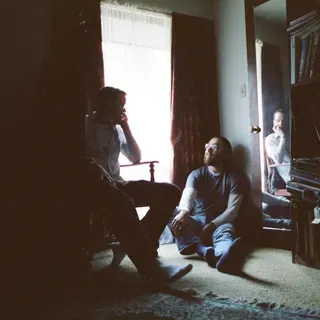

A brief and incomplete list of the places Small Talk by Whitney will soundtrack your life: hotel lobbies where nobody knows your name, elevators with too-bright lighting, a CVS aisle in 2034, or a minimalist taco joint charging $25 for three zigzagged slabs of corn. It will crop up between a completely generic AI-generated classic rock track and Edward Sharpe’s “Home” on a Spotify “Chill Indie Road Trip” playlist. Antidepressant commercials. Morning routines. Watch the album with your eyes closed and you’ll see a formerly melancholic woman running through a meadow in slow motion, arms flailing like she’s auditioning for a Hallmark ad. And maybe that’s unfair—Whitney’s personality-free soft rock isn’t only a soundtrack for pharmaceutical mediation; it could sell laundry detergent, orange juice, or the quiet thrill of neutral midcentury furniture. Range? Who needs it.
The Chicago band’s fifth album is ostensibly a breakup record, but it carries the emotional weight of a lukewarm cup of decaf. The lyrics catalogue the end of a relationship, almost always in vagaries, as if heartbreak were a polite suggestion. Julien Ehrlich croons, “I can’t talk without crying,” but his nasally, inexpressive delivery leaves the sentiment hanging like a forgotten RSVP. On “Damage,” he falsettos, “Little peace of mind for a troubled soul/Ain’t prepared for a future unknown,” a line meant to evoke aimless drifting but landing somewhere between a Yelp review and a midwestern poetry workshop. Schmaltzy strings and a Donnie Trumpet–style horn section attempt to inject drama but fail to rouse any real feeling. “Tragic, the way I used to dwell/Through it all I hope you stay well,” Ehrlich sighs later, a statement more suited for a Tumblr post than an aching heart.
Even in its strongest moments, Small Talk is background music for the faintly heartbroken. “In the Saddle” and “Evangeline” are prettily arranged, though the latter wastes guest vocalist Madison Cunningham, flattening her usually resonant voice into another ambient layer of nothingness. Opener “Silent Exchange” tries for Doobie Brothers via Grizzly Bear with a hint of dollar-store Bon Iver. It sketches a wedding guest hiding heartbreak in public—“Write my name in a line of guests/A hair too drunk to be overdressed”—a scene of emotional tension that is immediately neutralized by Ehrlich’s stylized falsetto. Drama is measured, polite, and ultimately absent.
And the rest of the album follows suit. Each song drifts at the same tempo, with the same hushed intensity, making the title track’s goopy, mind-numbing waltz feel like the thematic apex. Ehrlich muses about “fighters past their prime,” which may or may not be a sly acknowledgment of Whitney’s increasingly slow, shiny, and uniform output since 2016’s Light Upon the Lake. Small Talk is breezy to a fault: innocuous, perfectly inoffensive, but spiritually inert. The worst offense isn’t malice—it’s being so inoffensive that you’ll feel a quiet sting of existential annoyance when one of these tracks appears on a public playlist, imposed by algorithmic tyranny. You might not even notice it until it’s too late.
About the Author