In the fall of 1956, a scrawny 15-year-old from Hibbing, Minnesota—Robert Zimmerman, not yet Bob Dylan—was banging out rock’n’roll covers in a high school auditorium, playing with the kind of conviction that outpaces ability. On their scrappy take of Shirley & Lee’s “Let the Good Times Roll,” you can already hear a flicker of something restless: a kid chasing a sound too big for the room, too big for himself. Seven years later, that same kid—new name, new myth, new skin—was standing beneath the vaulted ceiling of Carnegie Hall, closing out a sold-out show with “When the Ship Comes In,” a song that felt less like prophecy than proof that he’d already outrun everyone’s expectations. Between those two moments, the distance is less measured in miles or fame than in invention. Dylan didn’t just grow up; he built and burned through a half-dozen versions of himself, each more implausible than the last.
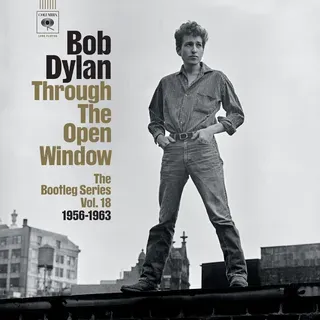
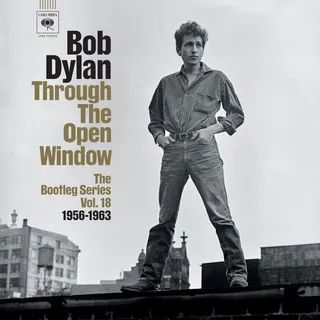
Through the Open Window, the 18th entry in Dylan’s long-running Bootleg Series, traces that transformation in exhaustive, granular detail. Spanning eight discs, 165 tracks, and nearly nine hours, it’s less a box set than a pilgrimage—an unspooling of sound and self across one of the most mythologized seven-year stretches in American music. Earlier Bootleg volumes have drilled into tight chapters of Dylan’s career—the electric cataclysm of The Cutting Edge, the born-again blaze of Trouble No More—but Through the Open Window reads like a novel. It’s a travelogue through shifting identities: the wide-eyed Midwestern rocker, the Village folk prophet, the reluctant generational mouthpiece. It feels like flipping through a stack of sepia-toned contact sheets and watching a face you recognize slowly come into focus.
The story opens at ground level, with that ragged “Let the Good Times Roll” rehearsal tape—barely a minute long, the lo-fi hum of teenage hunger. There’s no technique, no polish, just the charm of a nobody dreaming himself into somebody. But soon, the sound of the room changes. Dylan discovers folk, then Guthrie, then the idea of history as something you could rewrite in song. The guitars go acoustic. The phrasing stiffens, then softens. By the time he’s moving through “East Virginia Blues” with fellow traveler Danny Kalb, he’s already shedding his skin, learning to draw breath from a new tradition. What the set captures, better than any book or documentary, is that becoming—the raw material of transformation before myth calcifies around it.
These recordings show a Dylan still unsure of what kind of artist he might become, but dead certain that he will become one. You can hear the ego forming in real time—the brash kid who reads his own New York Times write-up aloud to anyone within earshot, the compulsive fabulist who claims he ran away with the circus or toured with Conway Twitty. Yet even at his most obnoxiously self-mythologizing, there’s a flicker of awe in his voice, as though he can’t believe the story’s working. That tension—between performance and revelation—becomes the defining pulse of the set.
One of the pleasures of Through the Open Window is how vividly it documents Dylan’s apprenticeship. There’s the harried studio chatter with Hugo Montenegro during Harry Belafonte’s “The Midnight Special” session, where a teenage Dylan fumbles a harmonica riff but refuses to let go of the moment. There’s a scattershot early attempt at “That’s All Right Mama” with a jazz combo that, in hindsight, feels like a ghostly premonition of the “thin, wild mercury” sound he’d later chase. And there are the home recordings—bare, aching renditions of “Pastures of Plenty” and “Remember Me”—where you can hear him stripping his voice down to bone and truth. This is Dylan still learning what not to play, still editing himself into focus.
By the time The Freewheelin’ Bob Dylan rolls around, the box set hits its stride. You can hear how much of it was assembled by force of will and accident—the dropped “Talkin’ John Birch Society Paranoid Blues,” the last-minute substitutions that reshaped the record into something harder, colder, more personal. Songs like “Masters of War” and “Girl from the North Country” sit beside each other like twin testaments: one to global apocalypse, the other to private ruin. The emotional intelligence that would define Dylan’s greatest work is already there—his understanding that intimacy and politics are often the same wound, just differently dressed.
The final discs capture the myth arriving fully formed: the Carnegie Hall performance of 1963, his coronation and his undoing all at once. The audience claps too early, too loud, as if to lay claim to him, and he responds with the defiance of someone already planning his next escape. “A Hard Rain’s A-Gonna Fall” lands like a sermon and a curse. “The Times They Are A-Changin’” feels both aspirational and exhausted, as though he’s watching history move faster than even he can write it. In those recordings, you can hear not only the weight of the era pressing on him but his refusal to be flattened by it.
For all its density, Through the Open Window never feels indulgent. Its length is part of the point—it insists that transformation takes time, that genius doesn’t arrive fully clothed but accumulates, awkwardly, through repetition and failure. Listening front to back feels less like an act of fandom than an act of witnessing: sitting beside a kid in a smoky coffeehouse and realizing he’s about to change everything.
By the end, when Dylan stands at Carnegie Hall—a voice no longer searching but declaring—you can sense the next fracture coming. The boos of Newport, the motorcycle crash, the exile, the return. All of it is contained here in seed form. This is the sound of Robert Zimmerman becoming Bob Dylan, and Bob Dylan becoming everyone else: the drifter, the prophet, the fraud, the savior, the poet laureate, the man who made American song elastic enough to hold contradictions. Through the Open Window is not a document of Dylan’s arrival so much as the map of every detour he had to take to get there.
And like the best Dylan stories, it ends not with resolution, but with a horizon—wide open, wind blowing through.
About the Author