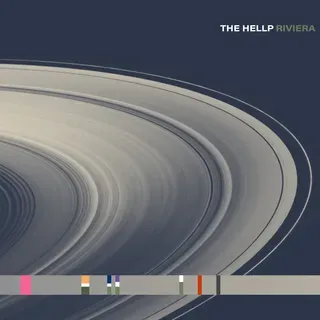
Los Angeles duo The Hellp have spent the last few years saddled with the “indie sleaze” tag, a term that now functions less as an aesthetic descriptor and more like shorthand for American Apparel-era debauchery packaged as nostalgia. But Noah Dillon and Chandler Ransom Lucy keep insisting their music is something else entirely—something “American,” not in the Bud Light/flag-decal sense, but in the mythic, shape-shifting sense of a culture built on reinvention and theft. Their whole project is a kind of scavenging futurism: Justice’s blown-out crunch, Phoenix’s at-dusk pop brightness, Salem’s doomy throb, Crystal Castles’ scorched glitch, and the inevitable Strokes-by-way-of-GarageBand riffs all get dumped into their centrifuge. Somehow, it spins.
Earlier releases—last year’s LL and their 2021 Vol. 1 compilation—felt like two kids gleefully hurling sound at the wall to see what might ooze down in an interesting shape. But Riviera, their second album, finally sounds like the pair have slowed down long enough to carve something recognizable out of the mess: a brooding, neon-smeared LA Gothic, equal parts synth-pop reverie and freeway existentialism. These songs orbit the same blacktop fantasies that fueled Allan D’Arcangelo’s freeway paintings, except here every off-ramp loops back into a haze of déjà vu, heartbreak, and late-capitalist drift.
Cinematic opener “Cortt” builds itself out of Moog-like pinpricks that glimmer like gas-station signage at 2 a.m. as Dillon sings about driving into the city in search of revelations he knows won’t arrive. “Here I Am” dives straight into the belly of the beast: horn-like pads rupture into a strangled, metallic squeal, and guest singer Maggie Cnossen channels an “OK Cupid”-era Kitty monotone for a chorus that feels like a nihilistic nursery rhyme—“From LA to LA/La la la.” Riviera’s world expands and contracts around that loop: the illusion of freedom, the reality of circling the same exits until the pavement starts to look familiar.
When Riviera clicks, it does so with the electric, scrappy charge that made The Hellp’s earliest experiments so compelling. “Revenge of the Mouse Diva” is a highlight, the band’s most Deerhunter-adjacent spiral yet—drums detonate like thunderclaps, synths sizzle with static, and the whole thing vibrates with the humid foreboding of a desert storm gathering in the dark. “Live Forever” tiptoes on the knife’s edge between sublime and stupid, redeeming itself with airhorn-coded synths and Cnossen’s velveteen phrasing. It’s the kind of track that only works because it refuses to care whether it works.
But sometimes the duo’s polish gets the better of them. “Doppler,” all acoustic haze and wistful synth plumes, contains some of Dillon’s sweetest reflections on time slipping through your fingers, yet its haziness dips dangerously close to the somnolent. You start to wonder whether “Riviera” is a destination or a dissociative state.
Despite the band’s claims of forging their own aesthetic nation-state, the record is still thick with references. “Country Road” nods to John Denver with a kind of perverse sincerity; “Revenge of the Mouse Diva” takes its title from an essay on Karen Kilimnik, patron saint of American dream-decay. Meanwhile, their guest vocalists become archetypes—Cnossen the unbothered Valley Girl; visual artist Sophia Álvarez the retro screen siren murmuring “Riviera/Rivera sound” on “New Wave America,” as if delivering a séance for the Californian psyche.
That tension—between irony and earnestness, detachment and longing—runs through the album’s veins. In interviews, Dillon has described a childhood fantasy: cresting a hill in his hometown and imagining a hidden oasis waiting just beyond view. More important than what was actually there was the act of believing in the possibility. “Meridian,” maybe the album’s emotional apex, channels that feeling. It begins in the lo-fi crackle of a faraway payphone before erupting into a glossy, almost embarrassingly sincere pop-rock chorus: “Does it feel like/You’re the solo act/’Cause it’s my heart/You’re the only one.” It’s a love song for the imagined America, the one that might materialize if you keep driving long enough.
The roads on Riviera might lead nowhere, but The Hellp make a compelling case that nowhere is still worth exploring—especially if it glows in the dark.
About the Author