The latest work from Grenadian-Jamaican-American composer and artist JJJJJerome Ellis, Vesper Sparrow, is a deep, focused exploration of their guiding principle: the stutter as a musical instrument. Having long found liberation in the fluidity of the saxophone while experiencing shame from speech dysfluency (manifesting as a glottal block), Ellis eventually learned to perceive these involuntary pauses not as hindrances, but as moments of artistic potential. Socially, a block can cause confusion; musically, Ellis realized that same pause can dilate time, foster intimacy, and invite improvisation. For Ellis, following their stutter is now akin to trusting true intuition.
Ellis poetically refers to these speech blocks as “clearings,” evoking the image of an open space in a forest path—a term historically linked to places of congregation and prayer for enslaved African Americans. Following their 2021 debut, The Clearing—an intellectually rigorous, didactic project that burst with ideas across hip-hop, R&B, and jazz—Vesper Sparrow is a more concentrated effort. It acts less as a dissertation and more as a prose poem, focusing keenly on the nature of time. By suspending time for both speaker and listener, the stutter becomes a means of forging new connections.
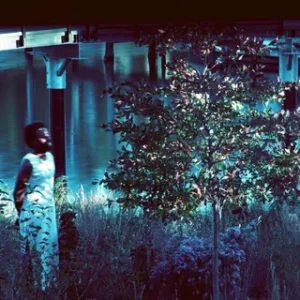
With significantly fewer spoken words than its predecessor, Vesper Sparrow emphasizes showing over telling how Ellis’ theory works in practice. The album’s central four-part piece, “Evensong,” begins with a necessary explanation, reminiscent of Alvin Lucier, as Ellis describes the process: “The music you’re hearing now I created using a process called [pause] granular synthesis.” That initial block is filled immediately by ecstatic saxophone, hammered dulcimer, and drifting vocals. The subsequent parts illustrate this process, as Ellis describes splitting sound into “grains” that disintegrate like raindrops, then later gathering them into a flood of sound.
The album’s conceptual and structural hinge arrives in “Evensong, Part 2,” when Ellis breaks mid-sentence: “When I make a piece of music, the music [pause]…”. This crucial gap is not silent; rather, it is filled with the substance of the album, forming a suspension that occupies two-thirds of the total runtime. Within this dilated moment, Ellis inserts two versions of the hymn “His Eye Is on the Sparrow,” recognizing their upbringing in their reverend grandfather’s church. The title track features sparse piano supporting Ellis’ soulful voice, its tentative delivery slowly joined by a saxophone that flutters like a sparrow’s wings. Later, on “Savannah Sparrow,” the hymn is stretched into a 16-minute pipe organ drone—a tribute to their grandmother—over which Ellis delivers a powerful, patient sax solo. Ellis notes that they “stutter on the sax, too,” which accounts for the instrument’s gripping presence, where every sound feels as considered as a loving, drawn-out conversation.
The resumption of the thought at the beginning of “Evensong, Part 3″—”…[pause] passes through me. It’s a seed I plant. The seed grows, mostly unobserved”—feels like a moment of time travel, containing the entire spiritual journey and intervening music within a single glottal block. This underscores the potential of the clearing as a space for meditation and connection. Ellis concludes by comparing the sonic “grains” to pollen carried “not by wind … but by the silence that authorizes and protects all music.” This idea reinforces the method of “Evensong,” as granular synthesis separates sound with silence, creating myriad tiny clearings that open infinite possibilities, which are celebrated in the exuberant, looping repetitions of the final movement. Vesper Sparrow ultimately shows that in the moments the world slows down for the speaker, as Ellis once experienced with an understanding cashier, it opens up a space for radical, beautiful co-performance.
About the Author