
On June 7, 2023, the sky over New York curdled into a strange, cinematic orange. The city’s usual gray hum—its honking, chattering, breathing—was muffled beneath a haze so thick it felt biblical. The air reeked of wildfire smoke drifting hundreds of miles from Canada, and as the day wore on, the horizon blurred into an unsettling sepia gradient. It was the kind of day that made you question whether the apocalypse would arrive quietly or on schedule between meetings. Strangers on the street took photos of the sky, texted “is this normal??” to their group chats, and went back to their laptops. For many, the dissonance was haunting: the world was on fire, and yet the trains still ran.
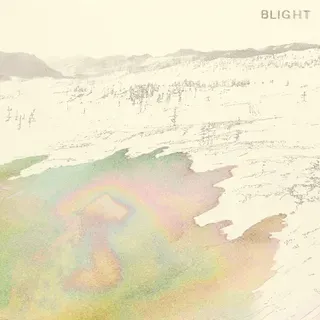
“Something in the Air,” the second single from The Antlers’ Blight, captures that same queasy normalcy—the way catastrophe can feel both spectacular and mundane. Over hushed guitars and a low, trembling synth, Peter Silberman sings in his signature falsetto, as if he’s whispering through the smoke: “Oh, keep your window closed today.” The track unfolds like a slow exhale, drifting between dread and routine: “Oh, be sure to charge your phone today / Oh, maybe work from home today.” The Antlers have long been labeled a “sad” band—sometimes reductively so—but here, Silberman turns that melancholy inward, finding poetry not in devastation itself but in the quiet denial that follows it.
The band’s reputation for exquisite sorrow was cemented with 2009’s Hospice, a conceptual gut-punch that used a hospice ward as a metaphor for a decaying relationship. It was grief rendered operatic, intimate enough to feel invasive. Across the following decade, Silberman’s work grew gentler and more spacious, trading catharsis for contemplation. On Blight, his gaze widens again—not toward a single lost love, but toward an entire planet in decline. The result is what he’s called a song cycle about “eco-grief,” a phrase that feels both clinical and tragically relevant.
Across nine tracks, Blight traces the emotional terrain of the climate crisis: dread, denial, guilt, and a faint, flickering hope. The songs drift like fog—ambient, elegiac, occasionally aimless. “Pour” and “Calamity” meditate on pollution and slow-motion ruin, their rhythms dissolving before they can fully form. “Consider the Source” opens with pastoral brightness, recalling the gentle glow of 2021’s Green to Gold, before slipping into self-reproach. “Is it enough to add to cart with buyer’s remorse?” Silberman asks, his voice hovering somewhere between confession and resignation. It’s an album that wants to grieve, but often sounds paralyzed by the scale of its own despair.
The record’s origin story is appropriately rural and introspective. Silberman wrote much of Blight during solitary walks near his upstate New York studio, surrounded by woods and farmland. He noticed a neighboring farmer cutting down trees to clear a path for machinery—a small, local act of destruction that echoed the global decay he felt humming beneath daily life. “Carnage,” one of the record’s most vivid moments, channels that tension: it begins as a skeletal synth meditation before erupting into a distorted spiral of guitars. “Accidental damage,” he wails, his voice dissolving into static. The song’s imagery—a headless snake, a toad crushed beneath a tire—is grotesque and tactile, the rare moment where Blight breaks its haze of abstraction and lets something ugly crawl into view.
The title track pulls a similar trick. “Chawed-up trees with skeletal leaves,” Silberman sings, his phrasing as delicate as the devastation he describes. Michael Lerner’s drumming fractures and recombines beneath him, subtle electronic textures mutating like spores. There’s a strange beauty to the decay, a sense of motion within stillness. Yet for every spark of experimentation, Blight has a song that drifts too far into inertia. Tracks like “Something in the Air” and “Deactivate” move so slowly they nearly evaporate, weighed down by stately arpeggios and endless sighs. The Antlers have always thrived in quiet places, but here, the hush can feel less like intimacy and more like avoidance.
Part of the record’s unease lies in Silberman’s moral self-examination. He doesn’t rage against faceless corporations or corrupt politicians; instead, he implicates himself—and, by extension, the listener—in the endless churn of consumption. “Quickly, I need it! / Shipped in a day / Oceans away,” he sneers on “Blight,” skewering his own convenience addiction. It’s an honest reckoning, if not a radical one. The Antlers’ critique feels strangely personal, as though Silberman is more comfortable mourning his own complicity than naming the real architects of destruction. The oil barons, the lobbyists, the climate-denying billionaires—they exist somewhere beyond the frame, haunting the album like shadows the songwriter refuses to chase.
.webp/:/cr=t:0%25,l:0%25,w:100%25,h:100%25/rs=w:1280)
That ambivalence makes Blight a curious artifact: an apolitical album about an inherently political crisis. Where Tamara Lindeman’s Ignorance located both fury and grace in the face of collapse, Silberman retreats into solitude, searching for small mercies in the smoke. In 2025—a year already marked by the dismantling of the EPA and fresh attacks on environmental policy—such inwardness feels both understandable and inadequate. The grief is real; the fire is literal. But sometimes, the gentlest elegy risks sounding like a lullaby for our own undoing.
The album’s closing track, “A Great Flood,” plays like a hymn for a world half-drowned. Over spare piano and flickering reverb, Silberman asks, “Of this I’m uncertain / Will we be forgiven?” It’s a question that hangs unresolved, trembling in the ash-filled air. Forgiveness, after all, presumes repentance—and repentance requires change. Blight doesn’t offer much of that, but it does capture the eerie stasis of our time: a species staring into the haze, phones in hand, waiting for the sky to clear.
About the Author