.webp/:/cr=t:0%25,l:0%25,w:100%25,h:100%25/rs=w:1280)
Rosalía has always treated pop like a divine experiment—one conducted with gasoline, tears, and God’s own Auto-Tune. Across her first three albums, she redrew the lines of what global pop could be. Los Ángeles was a ghost story built from flamenco tradition; El Mal Querer detonated that tradition, fracturing it into digital shards and reshaping it into something futuristic. Then came MOTOMAMI, her fearless hyperpop psalm—a world of motorcycle chrome, perreo, and maximalist emotion. Now, with LUX, she ascends again, this time not toward the club but toward the cathedral.
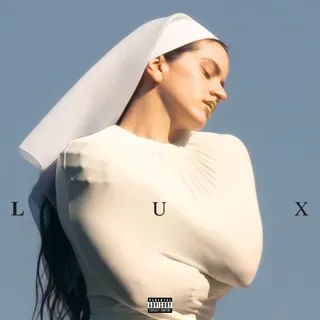
LUX is Rosalía’s fourth album, and easily her boldest—a baroque odyssey that moves like an opera but beats like pop. It’s arranged in four movements, sung in 13 languages, and constructed from orchestral, electronic, and folkloric vocabularies that she wields with serene control. The record isn’t trying to shock or seduce so much as to consecrate. Across its hour-long runtime, Rosalía uses every tool—her elastic voice, her precision in production, her capacity for drama—to wrestle with love, power, and belief. She isn’t merely blurring the line between sacred and secular; she’s dissolving it.
The opener, “Sexo, Violencia, y Llantas,” is a declaration of intent. “How nice it’d be, to come from this Earth, go to Heaven, and come back to the Earth,” she sings, her voice half-whisper, half-prayer. The song glows with celestial synths and low, percussive tremors, like a church organ reimagined for a spaceship. It sets the tone for LUX’s paradox: a record obsessed with transcendence but grounded in the body—its hungers, its pain, its resilience.
Throughout the album, Rosalía treats language like fabric, stitching Spanish, Catalan, Japanese, Ukrainian, and Italian into one seamless tapestry. “La Rumba del Perdón” transforms flamenco into an act of absolution, with Estrella Morente and Silvia Pérez Cruz offering harmonies that feel ancient and alive. “La Perla” pirouettes between venom and grace, a waltz that slices ex-lovers with the precision of a scalpel: “emotional terrorist,” “red flag andante.” It’s the kind of song that belongs next to Fiona Apple’s most surgical heartbreaks. In contrast, “Mio Cristo” deifies loss—“My Christ cries diamonds,” she sings, her voice breaking into glittering fragments. Between these extremes—retribution and surrender—Rosalía locates the divine mess of being alive.
Even the album’s humor is laced with provocation. “Novia Robot” plays like a late-night infomercial from hell, advertising an obedient, customizable girlfriend. Over elastic beats and metallic clinks, Rosalía dismantles patriarchal fantasies with a wink, reminding us that no machine can replicate what makes her human: imperfection, defiance, the thrill of disobedience. “Porcelana” follows like a fever dream, a snarling rap that glitters with masochistic glamour. And then there’s “Focu’Ranni,” a standout that feels like a spiritual sequel to “Pienso en tu mirá,” all chopped vocals and radiant melancholy, hovering somewhere between mourning and rebirth.
What makes LUX extraordinary isn’t just its scope, but its devotion. You can feel Rosalía studying her saints—Teresa de Jesús, Sun Bu’er, Hildegard von Bingen—and transforming their ecstatic writing into the language of pop. “Sauvignon Blanc” opens like a vow of renunciation: “My God I’ll obey… I’ll burn the Rolls-Royce… tiraré mis Jimmy Choos.” She trades diamonds for divinity, finding clarity in sacrifice. On “Reliquia,” she laments fame as both burden and offering: “My heart’s never been my own.” It’s a lyric that sounds like both prayer and curse, as if sainthood and celebrity were merely two sides of the same gilded coin.
But for all its theological undertones, LUX never feels academic. Rosalía may quote philosophers and saints, but the emotion is always immediate, beating with pop’s essential pulse. She sings like she’s trying to save herself—sometimes through sound, sometimes through surrender. On the vinyl-exclusive “Dios es un stalker,” she becomes an unhinged deity, whispering “I’m your shadow” over a skeletal beat and glassy choral textures. It’s the record’s most terrifying and tender moment, collapsing obsession and devotion into one blasphemous confession.
Heartbreak lingers everywhere in LUX, an echo of her 2023 breakup with Rauw Alejandro. Yet instead of wallowing, she reframes the loss as spiritual metamorphosis. The record’s final movement, anchored by “Memoria” and “Magnolia,” turns grief into grace. “Life flashed me its knife, took everything I had, and I thanked her for that,” she sings in the closing moments. The lyric could belong to a mystic or a martyr—or just a pop star learning to let go. The circle is complete: she has ascended, descended, and returned to Earth changed.
LUX joins a lineage of records that treat pop as high art and high art as emotional survival—Vulnicura, Ys, MAGDALENE, Titanic Rising. It’s lush, demanding, sometimes overwhelming, but never opaque. The “bangers” are there, if you know where to listen: in the tremor of a string section, in the echo of a chorus, in the silence before she inhales.
Rosalía has always been a master of transformation, but this time she’s building a cosmology. She’s rewriting the rules of what pop can express and how holy it can feel.
“When God descends, I ascend,” she sings on “Magnolia.” “And we’ll meet halfway.” That line might as well be her entire career’s thesis—a bridge between Earth and heaven, body and soul, tradition and technology. LUX isn’t a pop album in the ordinary sense; it’s a new gospel for the restless and the devout, the broken and the divine.
About the Author