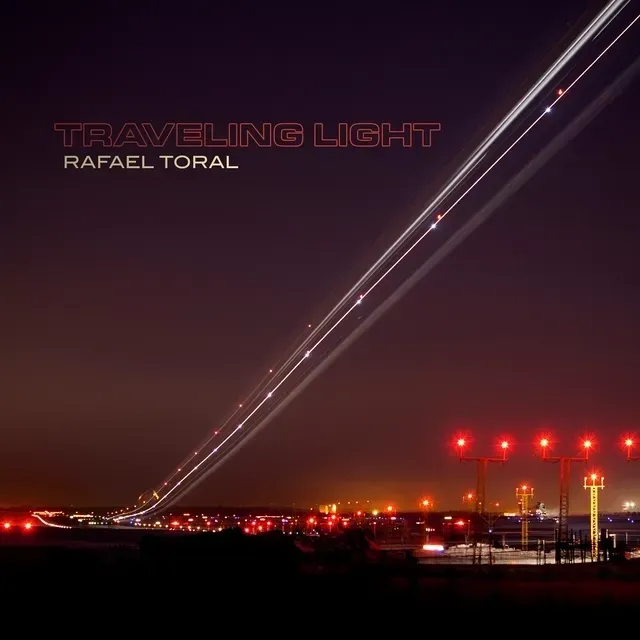
Rafael Toral has always treated sound like a living organism—something that breathes, shifts, and occasionally collapses under the weight of its own beauty. Over three decades, the Portuguese composer has journeyed from glacial guitar ambience to alien electronics, from meditative stillness to restless experimentation. His early landmarks, Sound Mind Sound Body (1994) and Wave Field (1995), reimagined the electric guitar as a vessel for endless sustain, each tone unfurling like a comet’s tail. When he abandoned the instrument for his Space Program, he became something like a lone astronaut transmitting from the void: his hand-built electronics squealed, burbled, and buzzed, their voices neither human nor machine, but something tenderly in-between.
By the time Spectral Evolution arrived in 2024, Toral had discovered a new kind of gravity—one where those abstract electronics brushed up against the harmonic ghosts of the Great American Songbook. He wasn’t simply referencing jazz; he was translating it, bending its chords into vapor trails, stretching rhythm into radiant suspension. Traveling Light extends that vision but also folds it inward. If Spectral Evolution was about dissolving standards into spectral mist, Traveling Light brings them back into view—still luminous, but softened around the edges, as if heard through the static of memory.
Toral has always been patient, but here his patience takes on a devotional quality. Each track moves with the deliberation of breath, elongating familiar melodies until they hover on the verge of disappearance. “My Funny Valentine” begins almost literally: the melody is clear, fragile, trembling like a candle in low air. But as the piece unfolds, its structure begins to liquefy. Chords bend into vapor, notes bleed into one another, and the tune you think you recognize becomes a dream about itself. Toral doesn’t simply play standards—he disassembles them into frequencies, examining their molecular shimmer until all that’s left is light.
Where Spectral Evolution buried jazz progressions beneath clouds of tone, Traveling Light exposes their bones. The melodies of “Body and Soul” or “Solitude” emerge in slow motion, every phrase stretched to its breaking point. You can almost feel time dilating around them, each sustained note trembling with the tension of being held too long. The effect recalls Brian Eno’s generative calm or Éliane Radigue’s monastic focus, but Toral’s approach is more emotional, more human. His drones breathe. They hesitate. They sound like they might vanish at any moment.
This is not a solitary experiment, either. Traveling Light feels communal, the work of a small ensemble whose spirits are in quiet orbit around each other. Clarinetist José Bruno Parrinha, saxophonist Rodrigo Amado, flügelhorn player Yaw Tembe, and flutist Clara Saleiro join Toral in shaping this gravity-defying atmosphere. Their presence is spectral, drifting in and out of the mix like ghosts passing through curtains. On “Body and Soul,” Amado’s saxophone seems to materialize from fog, a single line of melody cutting through the drone before fading again into the ether. Saleiro’s flute on “God Bless the Child” trembles with such intimacy it feels like breath on glass—earthly and divine in the same exhale.
Despite its weightless pacing, Traveling Light is never static. Beneath the surface hum lies a meticulous architecture of motion. Toral layers tones that shimmer and warp against one another, creating delicate friction—tiny ripples in the calm. At times, the music feels like it’s breathing on your behalf, expanding and contracting in long, tidal waves. Each phrase folds into the next, until what began as jazz becomes something like light therapy for the soul.
The album’s title is almost a provocation. “Traveling Light” suggests both movement and surrender—the act of shedding everything heavy. That paradox sits at the core of Toral’s work. His music is dense with detail but feels translucent, its beauty drawn from restraint rather than abundance. Listening to it is like staring into a night sky and realizing the stars are humming back at you.
.webp/:/cr=t:0%25,l:0%25,w:100%25,h:100%25/rs=w:1280 "Rafael Toral: Traveling Light")
At its best, Traveling Light achieves something very few records do: it makes familiar melodies feel infinite. Toral takes songs that have been sung and played for nearly a century and refracts them through his own cosmology, where sound becomes both physics and prayer. He’s not interested in nostalgia or reinterpretation, but in what happens when a standard’s melody is stripped of its swing, its rhythm, its sentimentality—when it becomes pure vibration.
This is a record that asks for surrender. Its glacial pace and open structure invite you to stop listening for hooks and start listening for breath, resonance, decay. What begins as jazz gradually dissolves into a kind of secular mysticism. You don’t hum along—you drift. By the time closer “God Bless the Child” recedes into silence, the experience feels less like an ending than a slow ascent, as if Toral has found the faintest melody inside the void and set it free.
In a world where most artists look forward by speeding up, Rafael Toral continues to slow time down until it glows. Traveling Light doesn’t reinvent jazz so much as it remembers it differently—as an echo, a pulse, a fading light still capable of illuminating the dark.
About the Author