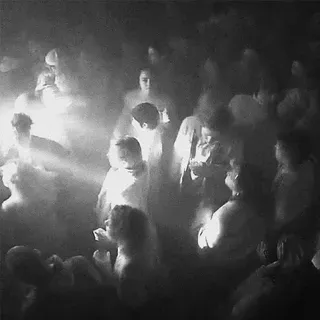

Even on her debut EP, released when she was just 22, feeo sounded like someone who had already lived several lives. She sang about choking fear and apocalyptic dread, about bombs that fell “like tears,” about waiting up all night to hear her lover leave so she wouldn’t wake to “haunted sheets.” Over hazy downtempo beats and gauzy synths, she asked questions with no expectation of comfort: Are we in love or is it just the drugs, babe?; Being lost is a bit like being free, isn’t it? Her music was full of unsteady yearning—intimate, self-aware, and oddly serene in its sadness.
It wasn’t just the precociousness of her writing that struck you—it was her composure. Feeo’s voice could be soft to the point of secrecy, yet it carried an unshakable poise. One moment she whispered her doubts, the next she unfurled a silken R&B run that reminded you just how much control she possessed. Even when her songs trembled with uncertainty, her delivery never did.
In the four years since, the artist born Theodora Laird has continued to sculpt her own world: collaborations with Caius Williams and Loraine James, a handful of EPs, and a production style that’s grown increasingly strange and spectral. Her music has become a study in minimalism—muted synths, faint guitars, and fragments of her own sampled voice looping like restless ghosts. Listening felt like peering into a sealed room coated in a fine layer of dust.
Her debut album, Goodness, released on London’s experimental label AD 93, deepens that isolation. The songs are quieter, the production more fractured, the emotions both larger and harder to grasp. The record opens with “Days pt. 1,” a monologue delivered not by feeo but by her father, British actor Trevor Laird, whose gravelly voice describes a surreal world where “pianos fall on the heads of infinite strangers” and photographs of the dead are “auctioned off in plastic boxes.” Behind him, blackened feedback hums like a dying city. It’s a chilling setup: a universe defined by cosmic absurdity and emotional collapse, into which feeo steps with the delicacy of someone sweeping up after a storm.
But Goodness isn’t a noise record—it’s still grounded in the tenderness of her voice. Stripped almost bare, the songs sound like sketches drawn on the edge of disintegration. “Requiem” floats her voice across soft synths and horns, a mist of grief and devotion. “Win!” turns the static and crackle of a dying circuit into rhythm, her sighs caught between language and silence. When she stretches her gaze beyond intimacy, her writing achieves new scale. “The Mountain” reads like scripture: a hymn to a creature so vast it could “tear me to pieces,” a metaphor for creation and destruction intertwined. “I’m only a witness,” she admits, in awe rather than fear.
“Here,” the album’s seven-minute centerpiece, crystallizes her world. Over harmonium drones and brittle guitar, she maps the alienation of modern London—a city of “crushing jobs and crushed hopes,” where minutes are counted “like lost loose change.” Her plea to escape with her lover is both mundane and mythic: Laid to rest in tall grass / When we are withered and old / But now we stay / Striking the pavement for gold. She’s one of the rare artists who can zoom out to cosmic scale and still make the smallest details feel devastatingly intimate.
When her father’s voice returns on “Days pt. 2,” the scenario flips: now it’s good things happening to bad people—villainous landlords, abusive men—receiving “infinite kisses from infinite wives.” The absurdity undercuts the heaviness; it’s a reminder that feeo’s worldview, though steeped in melancholy, still carries humor, irony, and self-awareness.
By the end, Goodness feels like an unspooling—of pain, of faith, of form. On “There Is No I,” a nearly unplugged closing track, she sings, When we’re together / We’re better together, her voice translucent over a weeping slide guitar. After an album of dense textures and existential puzzles, the simplicity lands like a revelation.
For all her world-weariness, Goodness shows feeo reborn through restraint. It’s the sound of an old soul learning to breathe again—quietly, carefully, beautifully.
About the Author