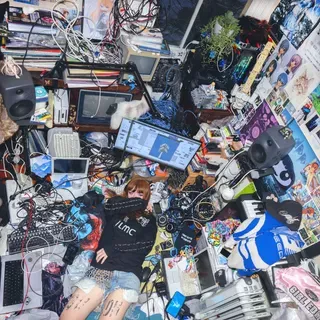
A friend once told me her issue with modern filmmakers is that they never get smartphones right. In her eyes, no one in movies ever scrolls, types, or doomscrolls as much as we all do. Maybe she’s onto something—most art still struggles to portray the simple truth that so much of modern intimacy, creativity, and chaos happens through screens. From Computer World to Imaginal Disk, plenty of musicians have explored the technological age’s sweep, but few have captured the raw, personal strangeness of loving a machine that knows you better than most people.
Enter Ninajirachi, the 26-year-old Australian producer who turns that idea into something both absurd and startlingly sincere. On her debut album I Love My Computer, she doesn’t just sing about her laptop—she practically courts it. The project’s centerpiece, “Fuck My Computer,” begins as a joke and ends as confession. “No one in the world knows me better,” she purrs, over a dubstep drop that could’ve scorched a 2012 festival tent. Across the record, Wilson toggles between irony and longing until the line between the two disintegrates. Her computer isn’t a metaphor—it’s a mirror.
I Love My Computer zips through EDM, speed garage, dubstep, and hyperpop like a tab left open too long, but it’s anchored by nostalgia for Australia’s golden age of dance music. On “Battery Death,” you can hear Flume’s maximalist shimmer; “All I Am” echoes PNAU’s euphoric house; and “iPod Touch,” the album’s emotional core, paints a vivid picture of teen life spent between beaches and browser tabs. Wilson evokes the sound of cheap speakers and sunburnt adolescence, where Triple J radio hits blared from cracked iPhones and Supré denim shorts were the height of fashion.
Despite its digital obsession, I Love My Computer isn’t internet music—it’s human music refracted through code. Wilson’s lyrics toggle between heartbreak and hard drive worship: she longs, she glitches, she uploads her feelings. “All I Want” closes the album like a fairytale reboot, where a girl falls into her screen and finds her soulmate glowing back at her. Elsewhere, “CSIRAC” turns the first Australian computer into a ghostly suitor whispering, I would never do anything to bring you harm. It’s creepy, tender, and oddly believable.
There’s a humor to Wilson’s sincerity, but it never undercuts the emotional weight. She doesn’t treat the internet as a villain or salvation—it’s just the air she breathes. Songs like “Delete” capture the thrill and shame of existing online, where posting a thirst trap can feel like a prayer. When she sings, “My heart’s alight, it’s because I’m so obsessed with you,” it’s unclear if she’s talking to a person or a machine—and that’s exactly the point.
In I Love My Computer, Ninajirachi doesn’t moralize about tech addiction or algorithmic doom. Instead, she shows what it feels like to grow up in symbiosis with the screen—to find love, selfhood, and distortion within its glow. It’s messy, funny, and heartbreakingly familiar. After all, who among us hasn’t whispered “I love you” to a glowing rectangle, just to see what it says back?
About the Author