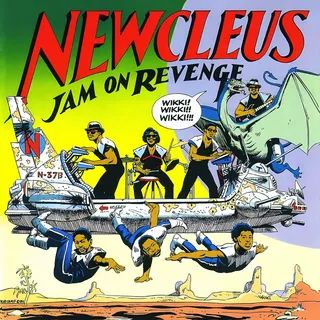
When Newcleus cut “Computer Age (Push the Button),” they couldn’t have imagined how sharply its anxiety would reverberate decades later. Filtered through a vocoder, the lead vocal reads like a dispatch from the frontline of consumer-tech fatigue: Everyone must have a machine… but I can’t stand it! The track pounds forward with the gleam of ’70s synth-pop refracted through a dystopian lens, collapsing into a break that feels like a control room melting down—alarms blaring, circuitry sparking, the future hissing at the edges. Like the best sci-fi, the song uses its neon rush to poke at the unease of the present, a present that in Newcleus’ early-’80s New York meant cheap drum machines, rewired dancefloors, and the first contours of a new electronic vernacular. The reissue of Jam on Revenge isn’t just archival—it’s a reminder that the blueprints from that era still have plenty to teach.
The album is studded with sharp, instinctive songwriting, but its gravitational center is “Jam on It,” the 1984 single that slipped to No. 56 on the Billboard Hot 100 and helped define a generation’s electro imagination. Its mix of menace, optimism, and slapstick surrealism—alien MCs, battles with Superman, New York saved through sheer DJ flair—felt like worldbuilding in real time as Roland’s new machines crept into every corner of Black music. Those staccato 808 cowbells, the rubberized bassline, the gravity-defying vocal routines: roller rinks didn’t need visuals, the sound already conjured the universe. And 1984 was a hinge year. Beat Street pushed breakdance, DJing, and graffiti into mainstream cinema, soundtracked by staples like “Planet Rock.” Newcleus shared festival lineups with Run-D.M.C., Whodini, and the Fat Boys as hip-hop scaled arenas for the first time.
Their path to Jam on Revenge wasn’t linear. The collective that became Newcleus emerged in ’70s Brooklyn as Jam-On Productions, a loose DJ, MC, and party unit spinning funk and disco while inadvertently mapping the outer limits of what was possible. The core lineup assembled through family ties: Ben “Cozmo D” Cenac and Yvette “Lady E” Cook; Ben’s cousin Monique “Nique D” and her partner, Bob “Chilly B” Crafton. Cozmo and Chilly handled production and writing, but everyone sang, everyone shaped the texture. Early demos under the name Positive Messengers carried a spiritual glow, but more importantly, they revealed a cinematic instinct—songs engineered like scenes, built from the new toys Cozmo picked up at Electro-Harmonix.
Ironically, the track that crystallized the group’s sci-fi persona began as an inside joke. Brooklyn, Cozmo recalled, was overrun with sing-songy, routine-heavy rap records that struck them as corny. So he wrote an “anti-rap” parody, “Jam on Revenge,” complete with chipmunk taunts and space-age swagger intended to mock a local DJ who’d dismissed them for not scratching. Tacked onto the end of a demo, the track became a party favorite and eventually their first single. Hits, in that era, could surface from the least serious corners. Their quirks—the squeaky voices, the theatricality—trace straight back to P-Funk’s cosmic comic opera, but Newcleus repurposed that lineage with a futurist precision. “Automan” turns a cyborg’s lament into synth-heartbeats. “Destination Earth (1999)” moves like a ship caught in a tractor beam, bassline bending gravity. And though their records were rooted in electronics, the band toured with live instruments, self-taught musicians blurring the line between bedroom gear and stage theatrics.
Creative control, as usual, proved harder to hold. Jam on Revenge was mixed by WBLS disco DJ Jonathan Fearing, who made structural edits without the band present and barred them from the mixing room. His sensibility skewed club-centric rather than streetwise; those glossy revisions remain stapled to the reissue, credited with suspicious quotation marks. Newcleus saw no royalties, thanks to Sunnyview Records’ ties to infamous powerbroker Morris Levy. It’s the old story: new sounds, old machinery.
The group’s momentum tapered as hip-hop mutated through the late ’80s, though Ben Cenac reinvented himself as the mind behind the cult house project Dream 2 Science, with Lady E on vocals. Jam-On Productions lives on as an archive; Chilly B passed in 2010. A previously unreleased remix, “Disco Kryptonite,” breaks with their signature electro rigor—whistles, hand drums, a looser palette. Instead of feeling disposable, it loops back to the disco DNA that seeded the earliest Jam-On parties nearly half a century ago.
For all its futurist flair, Jam on Revenge is ultimately about the push-and-pull between individual vision and the vast systems—industry, community, daily grind—pressing against it. “I’m Not a Robot,” reborn from a Positive Messengers demo, reframes electro’s android metaphors into something painfully human: a man wrestling addiction amid the city’s static. “What he’s searching for is how to be free,” Cozmo sings, as invisible hands try to pre-program his fate. But the song insists on rebellion: They can’t stop me from living. Strip away the circuitry and the message is elemental. Even in the most alienating landscapes, there’s still a switch to flip, a button to push, a way to reboot yourself into something new.
About the Author