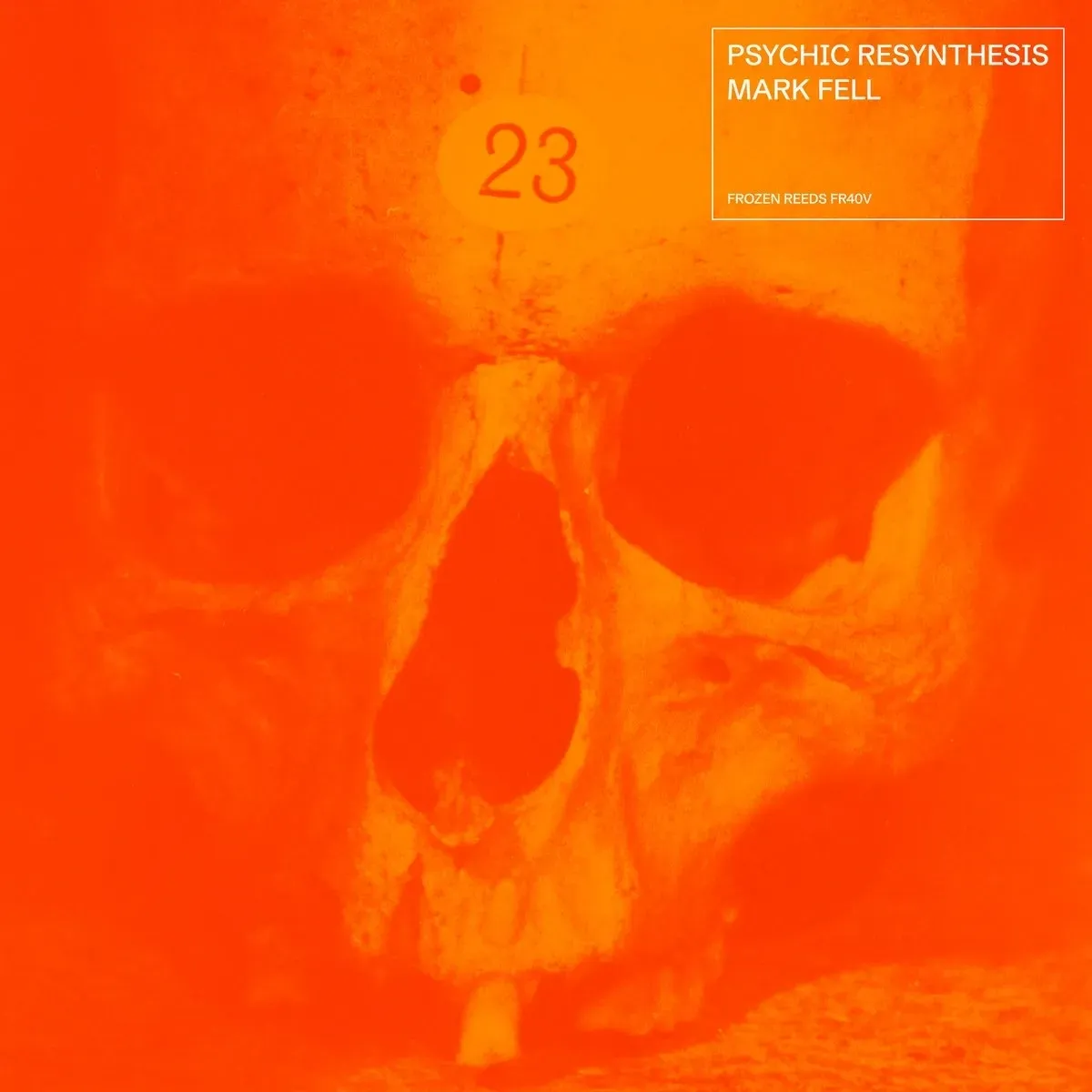
Mark Fell has always been an architect of impossible structures—someone who builds cathedrals out of data, balancing complexity and clarity until they almost cancel each other out. Across his career, the Sheffield producer has turned algorithmic systems into living sculptures, generating dizzying cascades of tone that feel as though they’re governed by physics more than feeling. His compositions—made largely in Max/MSP—are exercises in procedural beauty, shaped by the push and pull of closed systems and invisible rules. Even when you don’t fully understand what’s happening, you sense the machinery humming beneath the surface: equations mutating into sound, the math of music revealing its most emotional form through abstraction. Listening to Fell often feels like stepping inside a computer’s dream.
But Psychic Resynthesis, Fell’s newest album, shifts the frame. Instead of letting his machines dictate the motion, he hands the keys to an ensemble of living, breathing performers. The record, written for London’s Explore Ensemble, trades the blinking LED for the bow and breath—flute, clarinet, piano, violin, viola, and cello merging into something at once human and alien. It’s not the first time Fell has opened his code to interpretation (2018’s Intra used metallophones to physicalize algorithmic gestures), but Psychic Resynthesis feels like a redefinition of his language. This is the sound of software exhaling, the cold logic of computation tempered by the unpredictable warmth of touch.
The album opens with a single cello note—so unassuming you might mistake it for Bach if you weren’t paying attention. But quickly the illusion fractures: a violin scrapes across the frame, the piano hammers a dissonant cluster, the air begins to shimmer. Every sound arrives like an interruption, yet together they form a tenuous network of suspended motion. Fell’s compositions have always resisted traditional rhythm or harmony; here, he finds tension in stasis. The players orbit one another like celestial bodies, drawn into collisions by gravity they can’t see. The silences are just as important as the sounds—spacious, sometimes uneasy, like the empty rooms of a gallery installation where every creak is part of the work. For nearly 90 minutes, Psychic Resynthesis drifts between clarity and blur, never settling into coherence, yet always alive with microscopic change.
The track titles—“Combination #1 ( • | 6 | 4 | 3 | 2 | 6 )” and “Combination #4 ( 7 & 3 | 3 | 7 | 6 & 2 | 1 | 2 & 6 )”—read like data sets or passwords to a locked file. They hint at the score’s conceptual backbone: each performer is assigned a group of “behaviors,” fragments of musical DNA (a chord, a glissando, a pitch bend), to be repeated for indeterminate durations. They don’t rehearse together. They don’t even talk about their parts. Instead, their actions overlap randomly, governed by coded instructions designed to ensure that no two performances can ever be identical. In theory, it’s pure Fell—music as experiment, the process elevated over the product. But in practice, Fell cheats his own system: for this recording, he collected the musicians’ individual performances and reassembled them himself, disregarding the duration rules in favor of something that simply felt right. It’s the rare moment where the scientist gives way to the artist.
The result is astonishingly alive. Plucked strings spark like static in dry air; clarinets flutter like breath through glass. There are stretches where the music feels nearly frozen, then suddenly it melts into movement—small swells, accidental harmonies, faint human sighs inside the circuitry. You lose track of time. The piece seems to exist in a kind of suspended animation, where beginnings and endings blur. Fell has always been interested in what happens when rules break themselves, and here, that philosophy becomes tangible. The longer you listen, the more you feel your own attention dissolving—less a passive act than an altered state.
If Psychic Resynthesis is Fell’s descent into the labyrinth of live composition, then his Nite Closures EP is the trapdoor out—the return to the club, but through a wormhole. It’s also the inaugural release on his newly founded imprint, the wryly titled National Centre for Mark Fell Studies, dedicated to his solo electronic experiments. Across five tracks, he revisits the rhythmic instability that made earlier works like Multistability and The Neurobiology of Moral Decision Making both mesmerizing and maddening. The title track’s extended dub version opens with the glistening pads of his Sensate Focus era before fracturing into a nine-minute assault of non-repeating beats—footwork tempos folding in on themselves, each bar rewriting the one before it.
Elsewhere, “Nite Closures (version)” spins rubber-band synths and elastic percussion into a vortex that seems to teeter on the edge of collapse. It’s chaotic, yes, but the chaos has form—an uncanny elegance that makes even the most violent rhythmic convulsions feel deliberate. By the time “large modulos #3” arrives, Fell’s methods have reached a strange kind of serenity. Beneath the jagged gridwork of beats lies a soft, iridescent drone that glows like oil on water. It’s beautiful, almost embarrassingly so, the kind of beauty that sneaks up behind precision.
For all his talk of process, the truth about Mark Fell is that his systems have always been a disguise—a way of making emotion without sentimentality. Psychic Resynthesis and Nite Closures are two sides of the same prism: one refracts chaos into structure, the other structure into chaos. Both prove that even when he disappears behind algorithms, what emerges is unmistakably human. Fell doesn’t just build his castles out of splinters anymore—he’s learned how to make them breathe.
About the Author