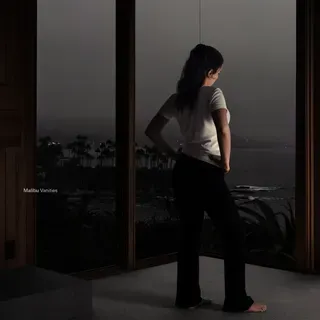
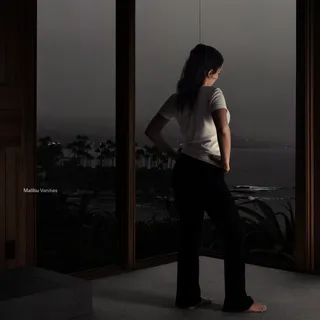
Vanities, the debut full-length from French producer Barbara Braccini, better known as Malibu, moves between devotion and disorientation. Across its brief, radiant ambient tracks, she layers vaporous synths with the ambient hum of city life—sirens, street echoes, distant machinery. The effect is both sacred and sterile, evoking images of deserted industrial zones or pandemic-emptied streets. Yet at its core lies her voice: clear, wordless, and reverent, like hymns trying to melt through a sheet of ice. The result is strangely cinematic—less like her ambient contemporaries and more reminiscent of the hypnotic alienation in films such as Bad Lieutenant: Port of Call New Orleans or Spring Breakers: cold, excessive, but ultimately cleansing.
Though Vanities was conceived in Stockholm and completed in Los Angeles, it feels born of California’s nocturnal haze—a modern L.A. noir rendered in synth and reverb. Sirens drift through opener “Nu.” “The Hills” bathes in ambient, new-age glow. And on closing track “Watching People Die,” a hushed voice murmurs, “It’s our secret, you can’t tell anybody,” like a line lifted from a half-forgotten ’90s thriller. The record luxuriates in contradiction: L.A.’s bright warmth and psychic isolation, its thin spirituality and ever-present luxury. At times, it echoes the ambient passages on Chromatics’ Kill for Love—that same serotonin-depleted beauty of driving through an empty city at 4 a.m., headlights diffused by fog.
Braccini explored similar terrain on her 2022 EP Palaces of Pity, but Vanities feels newly expansive. Her vocals, once buried beneath shoegaze haze, now float high and luminous in the mix. Details—a crash of waves on “Spicy City,” the tactile textures on “What Is It That Breaks”—are sharper, cleaner, more deliberate. Where earlier work felt submerged, Vanities breathes. For every song that implodes inward like “A World Beyond Lashes,” there’s another—“Lactonic Crush,” for instance—that rises softly, glowing with dream-trance lightness.
Calling Vanities “functional music” isn’t an insult. Braccini has described Malibu as a kind of diary, and many listeners have turned to ambient music as refuge from an overstimulated world. She embraces that restorative potential. The sighing release of “Contact,” a deep exhale in sound, is one of the most cathartic moments in her catalog. Across the album, she finds similar flashes of clarity—like breath returning after a long dive.
.webp/:/cr=t:0%25,l:0%25,w:100%25,h:100%25/rs=w:1280)
In the end, Vanities feels quietly hopeful in a way that Palaces of Pity never quite allowed. The record’s second half carries a sense of release, as if light is seeping back in. On the nine-minute title track, Braccini’s voice drifts above Oliver Coates’ elegiac cello like sunrise cutting through fog—peaceful, unhurried, pure. The closer, “Watching People Die,” despite its morbid title, achieves something close to grace: a simple pairing of piano and voice that slowly dissolves into static. It’s an ending that accepts mortality without fear, radiating calm. Vanities doesn’t transcend alienation; it coexists with it—and in doing so, discovers something like peace.
About the Author