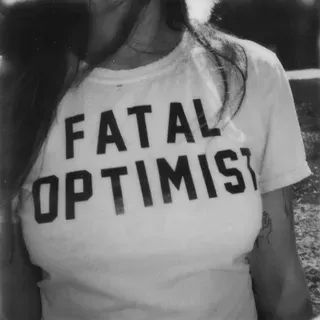
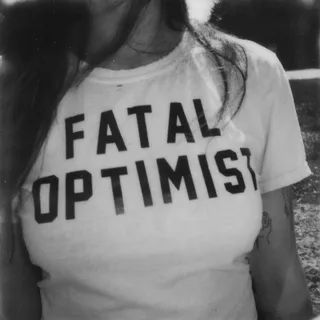
At the start of Madi Diaz’s Fatal Optimist, the “fatal” part lands first. On the opener, “Hope Less,” the Nashville songwriter sounds scorched by disappointment, her voice trembling over the tinny hum of a guitar that seems to reverberate through an empty room. “You want me to want less/And I wanted to need less,” she howls, each word snagging on its own restraint. The title’s pun reveals the quiet devastation beneath it—what she really wants is to hope less. It’s a devastating entry point into what Diaz has called the final chapter of her “heartache trilogy,” following 2021’s History of a Feeling—the record that finally pushed her beyond cult admiration—and 2024’s Weird Faith. Those albums mapped the anatomy of heartbreak and renewal with forensic precision: rage, jealousy, tenderness, and the fragile faith that keeps love alive after it’s burned you down. Fatal Optimist treads the same emotional terrain, but this time the landscape is stripped bare. Diaz stands alone in it, her songs less about the wreckage than the echo it leaves behind.
Written after another breakup, Fatal Optimist is Diaz at her most solitary. She worked with co-producer Gabe Wax (Soccer Mommy, Adrianne Lenker) to build a world as sparse as the emotions inside it—just her voice, her guitar, and the creak of empty air between them. That self-imposed isolation serves her writing well: without a full band to hide behind, her songs cut deeper. On “Feel Something,” she lashes out with desperate clarity, pleading to a checked-out ex—“You can call me if you feel something”—while her guitar thrums like a nervous pulse. “If Time Does What It’s Supposed To” sinks into a quieter grief; her voice barely stirs the air, surrendering to the inevitability of loss. These are breakup songs turned inside out, every flicker of emotion exposed under unforgiving light.
The record’s stillness is both its strength and its limitation. Diaz has always been a meticulous songwriter, capable of piercing observation delivered in unassuming melodies. But here, the focus on muted, guitar-bound ballads can blur the songs together. Tracks like “Good Liar” and “Why’d You Have to Bring Me Flowers” circle the same ache—clinging to love long past its expiration date—with such emotional accuracy that they start to collapse into each other. The emotional palette is grayscale, though painted with great care.
-e757e10.webp/:/rs=w:1280)
Still, Diaz saves a glimmer of relief for the end. The closing title track, buoyed by a full band, cracks open the album’s tight, airless space. After 10 songs of intimate autopsy, it feels like sunlight spilling through the blinds. “Forget I’ve ever been hurt/Forget the reasons why,” she sings, her voice suddenly bright, harmonies wrapping around her like friends at the end of a long cry. It’s both self-aware and deeply sincere—Diaz poking fun at her own inability to stop believing in love. In that moment, Fatal Optimist finally earns its second word.
There’s a line on “Heavy Metal” that crystallizes the record’s thesis: “My heart is heavy metal.” She sings it softly, almost tenderly, as if she’s still learning to believe her own metaphor. That’s the paradox Diaz keeps chasing—the strength that lives inside vulnerability, the resilience that only heartbreak can teach. Fatal Optimist might not stretch her sonic world the way Weird Faith did, but it hones her emotional language to a fine, gleaming point. It’s a quiet record about surviving quietly—a study in how even the softest voice can still echo like thunder.
About the Author