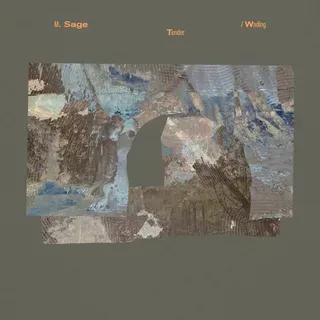
They say you can’t go home again. The landscape you remember will have shifted, the people will have changed, and you, most of all, will not be who you once were. Yet for M. Sage, homesickness was less a cliché than a calling. After nearly a decade in Chicago, the Colorado-born musician found himself yearning for the drama of his native state—the open skies, the creased horizons, the hush of pine forests at dusk. His 2023 album Paradise Crick had already tried to recreate that longing through electronic alchemy: an imagined countryside built from synthesizers, samplers, and field recordings. It shimmered with artificial crickets and digital creeks, a pastoral daydream that lived only in memory. “It exists in your imagination, hopefully,” Sage once said. “In your heart and in your memory.”
Between recording and release, that imagined landscape became a real one. Sage left the city and returned west, settling on a small plot of land in the foothills of the Front Range, about thirty miles from his hometown. There, in a barn he converted into a studio, surrounded by scrub, birds, and a young family, he made Tender / Wading. If Paradise Crick was a digital simulation of the natural world, Tender / Wading is its living counterpart—a work recorded amid the breath and pulse of an actual landscape. The album is both a sequel and a deepening, an acknowledgment that the fantasy of nature pales beside its unruly presence.
Still, this isn’t a grand statement about wilderness. Sage’s relationship with environment has always been personal, almost diaristic. His 2021 album The Wind of Things used field recordings from across the Midwest and Southwest—Illinois to Colorado, Wisconsin to Texas—to build vast sonic panoramas of the Great Plains, augmented by an ensemble of friends and collaborators. Tender / Wading folds that same methodology inward. The scale has shrunk from hundreds of miles to a few acres, from orchestral expanse to solitary reflection. The result feels like a meditation on homecoming—an intimate conversation between a musician and the world just beyond his doorstep.
.webp/:/rs=w:1280)
The album opens with “The Garden Spot,” where a chorus of Rocky Mountain toads croaks in counterpoint to a bright clarinet line. These field recordings are not mere atmosphere or ornament; they are the backbone of the record. Sage’s instruments move in deference to the sounds around him, never overpowering, always accompanying. On “Witch Grass,” when he layers guitar, percussion, and electronic textures into something that feels like a full band, you can still sense the porch light glow of collaboration between human and nonhuman players. Midway through, the music pauses—almost as if waiting for an owl’s cue—before resuming in quiet communion. It’s whimsical, but also reverent, a recognition that creation here is not about mastery but participation.
Sage is a skilled multi-instrumentalist, but Tender / Wading isn’t about virtuosity. It’s about discovery. Many of the album’s main tools—piano, clarinet—are relatively new to him, and that beginner’s touch gives the music a sense of humility, of openness to accident. The record’s centerpiece, “Open Space Properties,” begins with the clank and slide of a barn door rolling up—a literal invitation to let the outside in. A hesitant clarinet motif appears, then piano, then guitar; the arrangement grows patiently, adding drums and wisps of electronics until the song seems to breathe on its own. When it finally dissolves, we’re left with the murmur of the landscape: the creak of wood, the drone of insects, the gentle collapse of silence. The door remains open.
In spirit, Tender / Wading feels less like a retreat from the world than a recalibration within it. Sage isn’t escaping modern life so much as stepping sideways, trying to remember what listening feels like when technology stops mediating every sound. He has long been fascinated by the tension between organic and digital, and this album frames that relationship with quiet subversion. The video for closer “Tender of Land” makes that contrast explicit. Using vintage vacation slides of the Front Range, Sage fed the images into a machine-learning model and watched as the algorithm mislabeled them: the sky became grass, the mountains became pasture. “It can’t quite comprehend what it’s looking at,” he explains. “It starts to name things, and in doing so, creates a kind of poetics of failure that sees a hillside as a hare.”
That poetic failure is central to Tender / Wading’s worldview. Nature resists categorization; it slips through the grid. The album’s field recordings are full of sounds that computers, and perhaps even humans, can’t fully process: a rustle that could be wind or water, a low hum that might belong to a far-off plane or an animal unseen. Rather than clarifying these ambiguities, Sage leans into them, allowing confusion to become its own form of understanding.
There’s nostalgia here too, but not the sentimental kind. When Sage invokes the landscapes of his youth, he isn’t idealizing them—he’s acknowledging their distance. The hills, the barns, the night sounds are real, yet they also belong to a past he can’t quite re-enter. What he finds instead is something quieter but truer: the ability to dwell within the in-between.
Tender / Wading is not a wilderness retreat. It’s a negotiation with modernity, a subtle defiance of the hyper-connected world. In his barn-turned-studio, Sage has built a small refuge where human craft and natural process coexist, where a song can be both a field recording and a confession. It’s music that asks you to slow down, to notice, to listen—not to the idea of nature, but to its unpredictable reality.
And maybe that’s what homecoming really means. You can’t return to the place you remember, not exactly; time and experience have reshaped it beyond recognition. But you can rediscover the act of belonging—the feeling of standing in familiar air and hearing the world answer back. On Tender / Wading, M. Sage finds that delicate balance: not the illusion of going home again, but the quiet grace of finding yourself there anyway.
About the Author