
Last December, Virginia’s ladé slipped out Flexico, a chest-puffing EP that felt like a direct transmission from the mid-2010s SoundCloud underground. I’m talking plugg music in its golden era: Zaytoven-inflected beats, SpaceGhostPurrp-style flows, Uno and Fauni riding inseparable, MadeinTYO hopping in every Uber, and Digital Nas somehow feeling more influential than the guy who made Illmatic. Flexico first grabbed my attention with its cover art: a hand-drawn pair of eyes practically identical to D Savage’s D Phoenix, a touchstone of that moment. When I pointed it out online, responses came in like cryptic proclamations: “get wit da wave or drown #klan #ftw” and “klan shi fa eternity.” That’s when I learned ladé belongs to a loose Virginia collective called the Klan, and the wave he’s riding is both communal and fiercely territorial.
Two months after my Twitter epiphany, I watched ladé command a sticky Manhattan basement with no shirt, a mic in hand, and a dozen crew members circling behind him. This is hip-hop as ritual: a leader flexing authority, charisma, and technical skill while reinforcing the network of kinship and power around him. The Klan’s influence isn’t just visual—it shapes his approach to triplet flows, melodic melismas, and the plugg ethos he inherited. Unlike the scattershot experimentation of plugg’s early years, ladé’s curation is precise, deliberate.
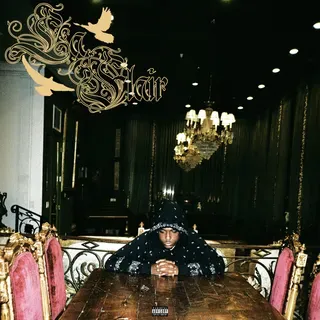
LaFlair, the chain-swinging, speaker-pounding debut he’s been building toward, showcases ladé as a next-generation heavyweight. On “Park Terrace,” he navigates ostentatious instrumentation—the oscillating bells, onomatopoeic gunfire, icy arpeggios—with a mafioso calm, blending braggadocio and reflection: “Always had to put my mama first / My folks always told me keep my word.” The tension between inherited street codes and new wealth pulses throughout the record, echoing the urgent, sink-or-swim energy of Migos’ early mixtapes. Even when he recounts near-misses on “Jesus Piece”—“Thank God I made it alive / ’Cause they tried to bend me and I ain’t break”—his delivery remains measured, controlled, a hunger more quiet than Migos’ in-your-face approach.
Conviction is everything, and ladé has it in spades. Lyrically, he treads familiar trap terrain, leaning on clichés, but his life and voice feel unvarnished, authentic. Where his writing sometimes lacks colorful novelty, his execution more than compensates. Hooks and verses flow seamlessly into one another, creating a continuous, hypnotic momentum. “Against Me or With Me” lulls with a lullaby cadence that never wavers, while “Corner” burrows into the brain with its deceptively repetitive hook.
The production on LaFlair feels like plugg music polished to perfection. Hitec’s “Find Her” recalls UnoTheActivist’s Live.Shyne.Die, a hyper-hypnagogic relic, while Jimmie’s work on “Against Me or With Me” layers plush keys and spectral synths, conjuring echoes of Thouxanbanfauni’s Heavy Weight Champ. At points, the instrumentals flirt with homage: BeatPluggz-style drums and sound effects pepper “Believe That” and “Had Dreams,” and Zaytoven-esque piano runs tie LaFlair to Future’s Beast Mode era. But mimicry is never a liability—ladé turns these familiar motifs into something his own, sliding effortlessly between earworm hooks and hard-earned ambition.
LaFlair doesn’t just revive a moment in SoundCloud rap history—it asserts ladé as a formidable architect of its future. With composure, charisma, and craft, he proves that plugg’s golden era isn’t a relic; it’s alive, evolving, and unmistakably his.
About the Author