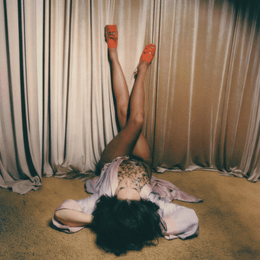

At the dawn of the new millennium, R&B was going through a transformation. The velvety power ballads that once ruled the 1990s were fading, making way for a sleeker, more hybrid sound—one that folded in electro, hip-hop, and pop to create visions of a futuristic dancefloor. London’s George Riley, born right in the middle of this cultural handoff, has absorbed that era’s glitz and pulse into her own artistry. On her new mixtape More Is More, she channels the high-shine maximalism of early-2000s R&B, treating it as both playground and study. The project bursts with glossy textures, cheeky confidence, and lush vocals that feel as much like homage as reinvention. Riley doesn’t just revisit the sounds of producers like Timbaland, Darkchild, and Dallas Austin—she reanimates their restless energy, spinning their chopped guitars, slippery synths, and syncopated beats into a thoroughly modern groove.
Riley’s signature wit and vitality run through every track. Since her debut just four years ago, she’s shown a remarkable ability to shape-shift without losing her center. Her breathy vocals first drew attention on Manchester producer Azn’s effervescent “You Could Be,” and her 2022 collaboration with Vegyn, Running in Waves, floated between neo-soul tenderness and electronic experimentation. Earlier this year, she morphed again, bringing sultry poise to SHERELLE’s high-voltage UK garage cut “Freaky (Just My Type).” These experiments form the scaffolding for More Is More, her most cohesive and confident project yet. Where her earlier work shimmered at the edges of genre, here Riley strides directly into pop’s golden hour.
The mixtape opens with “Something New,” a deliberate nod to All for You-era Janet Jackson. Its breezy tropical beat, nimble hi-hats, and featherlight synths evoke the early 2000s with uncanny precision, while Riley’s buttery harmonies give the track a contemporary lift. Halfway through, the rhythm pivots into a buoyant garage groove—a knowing wink that keeps nostalgia from calcifying into imitation. She threads the same spirit through “Forever,” produced by Mura Masa, a kaleidoscopic update of Kylie Minogue’s “Can’t Get You Out of My Head.” The track shimmers with Spanish guitars, breathy harmonies, and radiant synth waves that crest and recede like sunlight on water. These songs prove Riley’s talent for refashioning the familiar—she can twist a reference point just enough to make it feel reborn.
Much of More Is More was co-produced by phil, a frequent collaborator of PinkPantheress, another artist mining the Y2K era for inspiration. But while PinkPantheress blurs nostalgia through a hyperpop lens, Riley’s approach feels warmer, more tactile. She’s not reinterpreting so much as reviving—peeling back the gloss to find the sincerity underneath. On “More,” co-produced with Jordan Riley, she celebrates excess and self-love with winking confidence: “Gold on gold on gold on brown skin/Some say it’s tacky, but I love it.” Her tone—playful but assured—recalls the charisma of British girl groups like All Saints or Sugababes, filtered through her own perspective. Just before the track ends, it bursts into a quicksilver garage breakdown, bridging carefree early-2000s pop with today’s restless club energy.
.webp/:/cr=t:0%25,l:0%25,w:100%25,h:100%25/rs=w:1280)
Even as the mixtape brims with references, More Is More never slips into pastiche. Riley’s voice—cool, elastic, and full of sly humor—keeps it grounded in the present. She’s not performing nostalgia but conversing with it, using the past to explore her own identity and joy. There’s a gleeful self-awareness in the way she plays with pop’s surface pleasures, letting her lyrics about confidence, pleasure, and emotional independence glint beneath the glossy production. Every track sparkles with the sense that she’s in on the joke—and loving every second of it.
Ultimately, More Is More feels like a manifesto for Riley’s creative ethos. She isn’t chasing the minimalist cool that defines much of modern R&B; instead, she leans into opulence and emotion. The result is a project that honors her musical lineage while staking her claim as one of the UK’s most inventive young artists. For all its shimmering nostalgia, More Is More is less a trip down memory lane than a confident leap forward—a reminder that sometimes, excess isn’t indulgent at all, but necessary.
About the Author