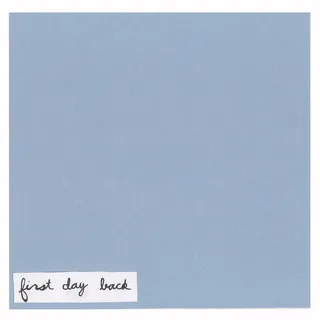
Nobody in First Day Back was alive to see a single VFW hall show in the ’90s, yet the Santa Cruz five-piece carries themselves like they were raised on flyer art, borrowed amps, and the Midwest humidity of second-wave emo. Their origin story feels appropriately scrappy: a freshman-year neighbor looking for a couch, a lamppost flyer asking for bandmates, a bassist stolen from a jazz ensemble because he loved Title Fight a little too much. By the time their first jam session ended, it was clear that singer/violinist Maggie, drummer Spencer, guitarists Nathan and Zion, and bassist Luke were united by a deep, borderline devotional love for Braid. They honored that obsession in the most emo way possible—by naming their band after a favorite song.
Their debut Forward—quietly self-released in June—spread like an unexpected lightning bolt through online emo circles, a record that seemed to materialize fully formed out of a Santa Cruz living room. Recorded by friend Benjamin Chung, the album is stitched entirely from live takes: no click tracks, no isolated parts beyond Maggie’s vocals, barely any post-production. You can practically hear drywall shake and someone’s roommate walking by outside. That rawness isn’t a gimmick—it’s the record’s glow.
Where many current bands lean into glitchy samples or hyper-maximalist song structures, First Day Back detour toward something earnestly old-school. The album begins with a ragged yell and tumbles straight into serrated post-hardcore rhythms, brainy interlocking guitar lines, and the kind of sing-scream catharsis that defined a generation too young to remember it. Each of the album’s nine tracks moves by emotional instinct rather than genre obligation.
“Paint” aches with the need to be alone long enough to create art; Maggie’s violin blooms into a second voice, fighting for space against the crash of Nathan and Zion’s fuzzed-out guitars. “Us,” one of Forward’s most gutting offerings, lives at the intersection of family turmoil and melodic restraint. Maggie’s voice tears as she sings about watching parents fight, and the band mirrors that rupture, building toward an emotional detonation that feels both inevitable and earned. So much of the album reads like private moments made public—screaming into a pillow, crying on a bus with your hood pulled down, whispering something raw into a voice memo you’ll never play back. Yet nothing feels melodramatic or manipulative; the band’s sincerity is too transparent for that.
Even the album’s closing track, the instrumental “Upstairs (212),” began as an off-the-cuff jam meant to capture the band’s collective quiet mood. That spontaneity threads through everything they do. The influences are obvious—Braid’s melodic tangles on Frame & Canvas, Cap’n Jazz’s chaotic playfulness, Jejune’s dream-pop harmonies—but First Day Back sidestep derivation. They don’t imitate their heroes so much as sit beside them in spirit, like kids invited into the classroom where ’90s emo was first being passed around.
Their shows carry a similar ethos: DIY spaces glowing with the “you had to be there” mythos of the era they missed—playing inside the bowl of a skate ramp or crammed against anarchist café bookshelves. Instead of pretending to be a revival, they chase the feeling of what they imagine it was like the first time around.
And then there’s Maggie, the band’s heartbeat. While Spencer occasionally sings from behind the kit, Maggie’s voice—bittersweet, scratchy, unguarded—makes Forward instantly recognizable. If Tim Kinsella shouts like he’s proposing on a roller coaster and Bob Nanna sings like he’s hosting a late-night show with one blown-out mic, Maggie sounds like she stayed up too late writing poetry, lost her voice, and still won the contest anyway. She whoops deliriously through “Wait, Do You Hear That?”, channels Sunny Day Real Estate-level yearning on “Gone On,” and sings every line like she’s bracing herself against its emotional weight. Live, she often tucks her hands in her pockets and closes her eyes, singing with the soft, instinctive vulnerability of a dog howling along to a distant siren. “I’ll squeeze my eyes some more,” she admits on “Sure, Ok.” “I’m hoping to be brought / Something reassured.”
Forward doesn’t just enchant on first listen—it’s one of those records that keeps popping up in Discord servers, Reddit threads, and late-night emo group chats with the same bewildered question: Where did these kids come from, and why doesn’t everyone sound like this? While Pittsburgh’s Short Fictions or Vancouver’s water margin tap into adjacent lines of the tradition, First Day Back hit the second-wave bullseye with startling precision and zero self-consciousness.
But if there’s an emo revival cresting again, First Day Back isn’t trying to lead it. They aren’t reinventing Midwest emo. They aren’t mythologizing it. They’re simply trying to feel—viscerally, joyfully—what it might have been like to live through it the first time.
About the Author