
Have you ever realized, mid-conversation, that you’re talking to someone’s press release? I recently caught up with a friend whose life had been rewritten in the years since we’d last spoken—a divorce, a new job, a new apartment, a new her. But every answer arrived pre-packaged, lined with familiar self-help syntax: boundaries, growth, gratitude, yoga. Her monologue sounded less like confession than performance—like she’d rehearsed her own redemption arc so many times that she’d started to believe it. It struck me as the kind of modern armor we all wear now: the narrative version of emotional SPF, glossy enough to deflect the mess underneath.
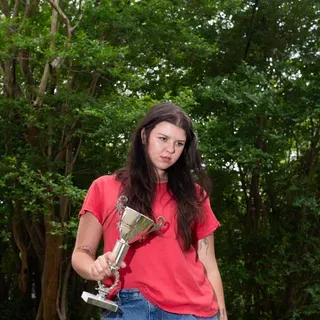
Eliza McLamb’s Good Story lives in that dissonance—between experience and the story we tell about it. “Catch it quick, frame the image, make your meaning before you’ve lived it,” she sings on “Mausoleum,” confronting her own instinct to chronicle rather than feel. Her 2024 debut Going Through It established her as a diarist of the digital overshare era—her writing laced with trauma, therapy, and Tumblr-era intimacy. But here, she zooms out. If Going Through It was an excavation, Good Story is the reckoning that follows, an album that wonders whether healing and storytelling are even separate processes anymore—or if we’ve learned to confuse the two.
McLamb builds that meditation atop sturdy indie-rock scaffolding with the help of a quietly stacked lineup: Jacob Blizard (Lucy Dacus), Sarah Goldstone (boygenius, Chappell Roan), Ryan Ficano, and Death Cab’s Jason McGerr. Together, they craft a world where Lilith Fair glow meets Eraserhead tension—lilting melodies that collapse into noise, whispering self-talk that swells into catharsis. “Better Song” closes with a minute-long guitar solo that sounds like it’s chewing through its own amplifier; “Promise,” the album’s most delicate track, dissolves into the pounding anxiety spiral of “Water Inside the Fence.” McLamb’s instincts as both essayist and musician shine through—her lyrics work like emotional reportage, her arrangements like the edits that reveal what language alone can’t.
At times, Good Story risks being too restrained. “California” and “Girls I Know” drift without finding the emotional altitude they’re reaching for, the music unable to match the gravity of the words. But when McLamb hits her stride, she does so with both ferocity and precision. “Like the Boys” turns gender envy into a pop-rock battle cry—“I like the boys like the boys like to shoot their guns,” she belts, grinning through the ache. “Suffering” starts as a wry lullaby (“Poor maudlin child… such tragedy”) before it explodes into pop-punk catharsis, McLamb dragging herself through the wreckage of self-pity: “If I’m without it, I can’t figure out the point of anything.” Her details are miniature photographs—vacuum-sealed chicken feet, lipstick melting in the sun, hair the color of dishwater—proof that she’s still writing from the raw, unfiltered place that first drew listeners in.
-678d519.webp/:/cr=t:0%25,l:0%25,w:100%25,h:100%25/rs=w:1280)
What makes Good Story so piercing isn’t its narrative coherence, but its willingness to dismantle narrative altogether. McLamb writes songs about writing songs, stories about the impossibility of telling stories truthfully. “Talisman” finds her glancing back at the past through nostalgia’s flattering lens—“Going back in time, I see everything fine”—and realizing that neatness itself is a kind of fiction. On the title track, she likens the urge to control your own story to “landing a plane three feet from the ground,” that doomed, almost-perfect descent that defines every artist trying to turn real life into something legible. She never resolves the tension. Instead, she turns it over like a stone, examining its shape and weight from every side.
By the end, she doesn’t find peace so much as freedom in the chaos. “I pick a fight just to see me win,” she sings. “I love getting free just because I can.” It’s a closing line that lands like a shrug and a manifesto all at once—a reminder that truth isn’t tidy, and good stories rarely are. In an era where everyone’s already rehearsed their next revelation, Good Story dares to be a little messy, a little contradictory, a little too human.
About the Author