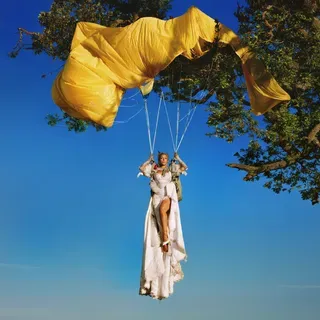
Doja Cat wants to feel free again. After 2023’s Scarlet—a fierce but weary project fueled by defensiveness and industry fatigue—she’s ready to let go. That album’s raw, bar-heavy energy often felt like an argument in motion: sharp, fiery, but constrained by anger. Looking back, Doja herself dismissed it as a necessary purge, “a massive fart,” in her typically irreverent way. With the tantrum over, Vie—her fifth studio album—marks a reset: a smooth, ’80s-inspired suite of love songs that promises levity and charm. “I’m doing what I was perfecting in the beginning,” she’s said. “I’m doing what I know I know how to do.”
One might expect Vie to polish the same magic that powered Hot Pink and Planet Her—those irresistible hooks, shape-shifting vocals, and agile flows that made Doja a genre-bending force. Instead, she reaches backward. Named after the French word for “life,” Vie abandons the glossy Y2K futurism of her earlier work for full-blown retro escapism. Working closely with Jack Antonoff—who has production or instrumental credits on nearly every track—Doja immerses herself in ’80s textures: pulsing synths, gated drums, and the occasional indulgent saxophone blast. There are even film samples from Body Double and Conan the Destroyer. It’s a maximalist nostalgia trip that substitutes immediacy with polish.
Doja’s connection to the era is less historical than emotional; she was born in 1995, after all. Rather than channeling specific icons, she captures the decade’s carefree ethos—when “girls just wanted to have fun.” On the glimmering synth-funk cut “Take Me Dancing,” her second collaboration with SZA, she turns post-romantic bliss into a dance-floor ritual: “You’re so raw, boy, and you’re so romantic / When you fuck me right, and then you take me dancing.” The roller-rink bounce, paired with her featherlight vocals, perfectly embodies the album’s playful spirit. She keeps the same sensual ease on “All Mine,” harmonizing with herself over glossy synths and warm keys.
But Vie falters when its commitment to pastiche clips Doja’s natural spontaneity. On tracks like “Jealous Type” and “Acts of Service,” her vocals and raps feel compartmentalized—her usually fluid interplay replaced by neat alternation. It’s as if she’s featuring herself rather than fusing her voices. The spark that once made every phrase feel alive now lives mostly in her rap verses.
“Couples Therapy” best captures that dynamic. Over a sleek groove, her singing is smooth and measured—but when she starts rapping, her personality detonates: “Cussing you out, you the one I resent / Cussing you out, I delete and re-send / Sorry, I got three selves, one’s 12 / Sorry, you gave me hell once felt / Sorry, honeymoon phase over now.” The fragmented phrasing mirrors a lover’s quarrel, playful and cutting at once. It’s a reminder of how much energy Doja generates when she collapses the boundary between rap and pop rather than enforcing it.
That fusion returns on the standout “Make It Up,” one of the few tracks that sidesteps the ’80s aesthetic entirely. Gliding over crisp keys and bass kicks, Doja shifts effortlessly between melodic rapping and crooning, layering ad-libs until the song closes in a soft countermelody. It’s vibrant, intuitive, and sticky—everything Vie occasionally forgets to be.
Doja has said Vie is her “poppiest” album yet, but its most compelling moments come when she lets her instincts blur the genre lines again. Scarlet burned hot and angry; Vie cools down, luxuriating in sound and style. Yet for all its shimmer and polish, the album’s true brilliance shines through when Doja stops performing nostalgia and simply plays.
About the Author