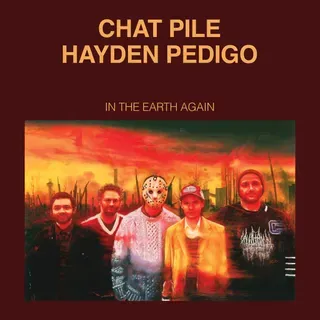

For all their noise and nihilism, Chat Pile have always been a band about care. The Oklahoma City quartet built their reputation on sludge metal that sounds like it’s clawing its way out of the American psyche—screaming about filicide, homelessness, and the rot of modern decay. But beneath the feedback and bile, their rage has always been rooted in empathy. When Raygun Busch howled, “Why do people have to live outside?” on their breakout single, it wasn’t just a political statement—it was a cry for tenderness in a world that rewards indifference.
Hayden Pedigo, the fingerstyle guitarist from Amarillo, Texas, has long channeled that same compassion through humor. His early antics—posing as a campaign-trail absurdist in a viral bid for city council—revealed a surrealist streak, but never one without heart. Over time, his public persona has softened into something startlingly sincere: long Instagram captions about grief, anxiety, and creative doubt that read like dispatches from the emotional borderlands of small-town Texas. Both Pedigo and Chat Pile have always been tricksters of tone—using irony to smuggle in earnestness, rage to express love.
That shared humanity forms the beating heart of In the Earth Again, their unlikely collaborative album. On paper, it reads like a thought experiment in aesthetic tension: John Fahey meets The Jesus Lizard, William Tyler swallowed whole by Eyehategod. But in execution, the record feels less like a collision than a merging—two magnetic fields folding inward until they hum at the same frequency. Born out of proximity (Pedigo moved just blocks away from Chat Pile bassist Stin last summer), the project began as a modest plan for a single and spiraled into a full-length LP. What emerged is not a split, nor a guest feature, but a singular organism: a drone-beaten prayer to the idea that beauty and brutality can coexist without contradiction.
The album unfolds slowly, like dawn breaking over a wasteland. Opener “Outside” begins with Pedigo’s pensive guitar, joined by Chat Pile’s Luther Manhole, Busch, and Cap’n Ron—whose usual percussive role is traded here for a ghostly lap steel. The piece drifts seamlessly into “Demon Time,” where Busch mutters a slow-motion prophecy: “They will find you / And they will fuck you up.” His tone is low, almost tender, as if narrating the end of the world to a child who’s already fallen asleep. The tension builds, suspended and unresolved, until “Never Say Die!” detonates halfway through—Chat Pile’s signature sludge roaring to life in a moment of pure, unfiltered catharsis.
The rest of In the Earth Again oscillates between extremes. “Behold a Pale Horse” is all atmosphere—Pedigo’s melancholy fingerpicking entwined with Manhole’s reverb-soaked guitar, the two trading melodies like hesitant conversation. “Fission/Fusion” crashes through with metallic fury, collapsing into something that recalls early Metallica if it were slowed to a crawl. On “I Got My Own Blunt to Smoke,” Busch stands alone with his guitar, bending a five-note descent into something weirdly operatic. His delivery lands somewhere between parody and confession, a reminder that Chat Pile’s darkest humor has always been a coping mechanism—a way of making horror survivable.
Not every experiment hits. The record’s eight-minute centerpiece, “The Matador,” is an exercise in ambition that doesn’t quite find its center. Tape loops and drones stretch out for nearly two minutes before the band lurches into motion; when the full groove arrives, it’s seismic, but the song drags under its own weight. “Things fall apart!” Busch yells, and they do—sonically and emotionally. But the sprawl also reveals the project’s fragility: In the Earth Again isn’t about perfection. It’s about testing the boundaries of restraint, about letting discomfort breathe.
.webp/:/cr=t:0%25,l:0%25,w:100%25,h:100%25/rs=w:1280)
The album’s final act is where it reaches transcendence. “The Magic of the World” feels like the emotional core—Busch’s voice suddenly unarmored, his lyrics devastating in their simplicity: “Before the life goes from my eyes / Before all magic is lost to time / You’re here with me / One more time.” The words hang in the air like smoke, fragile and final. Moments later, “Fission/Fusion” crashes back in, shattering the reverie; grief and noise, locked in an endless dance. And then the album closes on “A Tear for Lucas,” where Busch addresses a lost friend in a whisper. “You once shared the saddest thing to cheer me up / And it haunts me.” In 14 words, he captures what this entire project is reaching for: the unbearable intimacy of empathy, the way love can ache like a bruise.
For all its heaviness, In the Earth Again isn’t about despair—it’s about the labor of staying soft when the world keeps hardening. Chat Pile and Hayden Pedigo come from different corners of the musical map, but here, they meet in a shared dream: that sincerity and aggression, like soil and seed, can nurture each other. Behind the masquerade, they’re not summoning demons or saints. They’re simply asking the question that’s haunted their work all along: what if we could still be kind, even at the end of everything?
About the Author