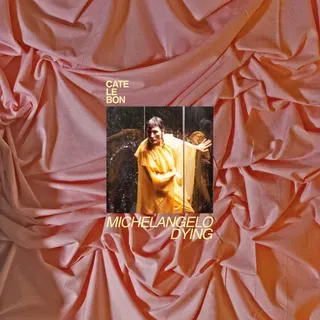
For the past 15 years, Cate Le Bon has been steadily building her own strange, shimmering world of sound. In Le Bon’s universe, guitars don’t just ring—they melt and twist like Dali’s clocks; synthesizers stretch out toward infinity; and words bend to her will, reshaping themselves inside her cool, metallic voice. Across six albums, she has moved from the playful oddities of freak folk to the sculpted precision of art pop, blending the influences of Bowie, John Cale, and Roxy Music into something unmistakably her own. Her singular sensibility has made her one of modern music’s most distinctive voices, as well as a sought-after producer for artists like St. Vincent, Wilco, and Dry Cleaning.
Where past records leaned on surreal abstraction and lyrical distance, Michelangelo Dying dives straight into the rawest subject of all: heartbreak. After nearly a decade living in Joshua Tree, Le Bon experienced the painful end of a long-term relationship and returned home to Cardiff, Wales. At first, she resisted writing about the breakup, throwing herself into producing for others and working on a completely different project. But her body rebelled—back pain, hives, and exhaustion followed her everywhere—until she finally surrendered to the truth of what she needed to say. “The breakup was always like an amputation that you don’t really want, but you know will save you,” she told The Guardian. In that surrender, she found release: “There’s a softness that comes from the surrender.”
Heartbreak may be one of the oldest subjects in art, but Le Bon’s take glows with a singular, mythic energy. On the haunting “Love Unrehearsed,” she sings of a woman “fit for a marble face,” asking, “Does she sleep like a stone ’cause you touch her more?” Her serene voice makes the accusation sting all the more. The song, from which the album’s title phrase is drawn, doesn’t reach a climax—it flows in cycles, like waves refusing to break. “Stay forever,” she sighs, “but you are so cruel.” The motion is hypnotic, endless.
Throughout Michelangelo Dying, Le Bon builds songs from looping patterns—Valentina Magaletti’s spacious percussion on “Pieces of My Heart,” her own buoyant bassline on “I Know What’s Nice,” Paul Jones’ bright, clipped piano on “Body as a River.” These repetitions anchor the music, even as guitars and saxophones swirl like storm clouds overhead. The effect is both meditative and purgative, as if each refrain scrubs away a layer of pain. On “Ride,” her duet with the legendary John Cale, the album dips into darker waters. Murky synths ripple beneath their intertwined voices, carrying the weight of time itself—the push and pull between love’s endurance and its inevitable decay.

For all its complexity, Le Bon’s music has always carried the pulse of pop. “Mother of Riches” unfolds in lush, spiraling layers of piano, percussion, and Le Bon’s luminous guitar, her voice stretching syllables into fluttering shapes. “I can’t remember what makes us elegant when love goes spare,” she sings, the final word trembling like silk in a gust of wind. It’s one of the record’s most stunning moments—both ornate and immediate.
Her storytelling brilliance crystallizes on “Heaven Is No Feeling,” the album’s centerpiece. Here, she toggles between husky lows and breathy falsetto, turning the simple phrase “What does she want?” into both an invocation and a curse. The man she describes “occupies space like a ribbon untied”—a line that captures both disarray and grace. Saxophonist Euan Hinshelwood’s mournful tone weaves through her vocals like smoke. As the song dissolves, Le Bon repeats “hello?” again and again, her voice thinning until it disappears. It’s a question without an answer, a call into the void.
By the album’s end, Le Bon stands alone—but not broken. Michelangelo Dying is a portrait of transformation through loss, a record that doesn’t seek to mend heartbreak so much as to inhabit it fully, to see what beauty survives inside the wound. In her world, love and pain are carved from the same marble—cold to the touch, but eternal.
About the Author