On his debut album, the San Francisco producer revives the DNA of ’90s ambient techno—not as nostalgia, but as inheritance, crafting something that feels both archival and strangely futuristic.
Anyone stumbling across Cahl Sel’s Blue EP earlier this year might’ve thought they’d unearthed a long-lost artifact from electronic music’s utopian past: all crystalline drum programming and billowing synths, glowing like data projected on water. It wasn’t. Behind the alias is San Francisco’s Jasper Sharp, a young producer with an old soul, whose work reanimates the optimism of ’90s ambient techno without ever lapsing into pastiche. He doesn’t so much recreate the era’s sound as exhume it, brushing the dust off and asking what it still has to say in a century where the future feels like a memory.
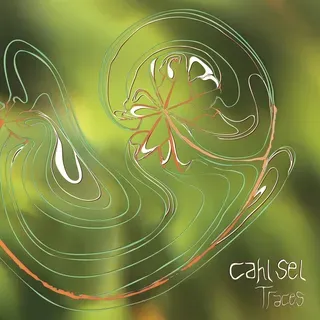
His debut album Traces, out via Reflective, makes that question its mission. The label itself is practically a ghost: founded by Jonah Sharp (aka Spacetime Continuum) during IDM’s luminous mid-’90s bloom, Reflective lay dormant for 25 years before resurfacing in 2022 to release Cahl Sel’s debut EP. The connection isn’t just symbolic. Jonah Sharp is Jasper’s father, and the younger Sharp grew up in the radiant afterglow of his dad’s generation—a time when electronic music still believed in transcendence through circuitry. Traces feels like the sound of that belief flickering back to life.
The album’s opening track, “Blink,” captures that sensation immediately. Its hi-hats shimmer like fluorescent dust, suspended in a state of perpetual motion that never quite resolves into a drop. The kicks are precise but weightless, like they’re keeping time in zero gravity. You expect it to lift off, but it doesn’t—it just hovers, radiating an almost unbearable calm. There’s no bassline anchoring it, just the sense that you’re drifting toward something that never arrives. This is dance music built on restraint, propulsion without release.
“Call to Mind” dials that tension inward. The tempo slows, the percussion softens into vapor, and Sharp’s arpeggios unfurl like tiny mechanical prayers. His production feels impossibly clean, but not sterile; every sound seems to hum with a quiet warmth, as if the machines themselves were sighing in their sleep. When the drums fall away entirely on “Livin,” you’re left with a network of tones that evokes the ambient psychedelia of the BBC Radiophonic Workshop—otherworldly but intimate, like eavesdropping on a signal meant for someone else.
-a0aba07.webp/:/rs=w:1280)
Cahl Sel’s palette is tactile in a way that feels almost retrograde. He builds everything on hardware—synths, sequencers, drum machines—relics of a pre-laptop era when you had to touch the sound to change it. You can hear it in the friction between his elements: the hi-hats that sound hand-cut, the synths that shimmer with slight detuning, the drum hits that breathe just enough to remind you there’s a human guiding them. Where so much modern electronic music prizes clinical precision, Traces glows with imperfection. It’s not lo-fi, but it is deeply lived-in.
There are moments of propulsion, too. “Left Eye” rides a clipped electro groove that recalls early Gescom or Bola, its edges softened by gauzy pads that swirl like heat mirages. “Ancient and Distant” is the album’s most haunting piece, an echo of Autechre’s Amber rendered in watercolors. The synths oscillate just out of tune, evoking the emotional dissonance of something beautiful slipping out of reach. “Clear,” one of the record’s most affecting cuts, fans its harmonies into a slow-motion sunrise—each chord rising, refracting, and dissolving into the next like light through fog.
Sharp’s influences are impossible to miss, but what’s remarkable is how he filters them. You can trace lines back to Aphex Twin’s Selected Ambient Works 85–92, Boards of Canada’s dusty nostalgia, even the dubwise undercurrents of Burger/Ink’s Las Vegas. Yet none of it feels imitative. Sharp treats those records less as templates and more as found fossils, shaping his own distinct language from their fragments. The result is music that feels timeless not because it escapes history, but because it’s acutely aware of it.
The familial lineage adds another layer. It’s tempting to frame Traces as the son completing the father’s unfinished project, especially given how Jonah Sharp’s music envisioned a digital Eden that never quite materialized. But Jasper isn’t simply carrying a torch—he’s holding a mirror. The utopian idealism that ran through ’90s ambient techno—its sense that technology could heal, connect, and elevate—has curdled in the years since into something more complicated. Cahl Sel’s music recognizes that contradiction. His compositions shimmer with longing but are shadowed by melancholy; they sound like transmissions from a world that believed in the future and now isn’t so sure.
That tension is the key to Traces. It’s not nostalgic so much as haunted by nostalgia. You can hear it in the wistful chord progressions, in the way his melodies reach upward but never quite break free. The music doesn’t mourn the loss of the past; it mourns the loss of the possibility the past once held. Listening to it feels like revisiting an early internet dreamscape and realizing the hyperlinks don’t work anymore.

If there’s any lesson to Traces, it’s that reverence can still be radical. Sharp doesn’t hide his influences, but he uses them to rebuild a sense of wonder in a time when irony and detachment dominate the electronic landscape. Where many of his peers chase maximalism or AI-assisted spectacle, Sharp doubles down on feeling. His music glows with quiet conviction: the belief that melody still matters, that rhythm can still move you, that beauty—however fleeting—is still worth chasing.
By the time Traces closes, it’s hard not to feel like you’ve been somewhere—though where, exactly, is impossible to say. Maybe it’s a memory. Maybe it’s a simulation. Maybe it’s the sound of ambient techno realizing it’s still got a few new dreams left to chase.
Cahl Sel’s debut isn’t just a callback to electronic music’s golden age—it’s a reminder that even in a world obsessed with algorithmic novelty, there’s still magic in the human touch.
About the Author