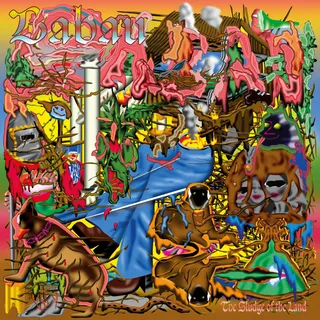
On “The Sludge of the Land,” Babau operate in the uneasy space where fantasy, history, and overload collide. The track draws a long, crooked line from the glossy escapism of mid-century exotica to a present-day world saturated with samples, references, and cultural debris. Rather than polishing these influences into something comforting, Babau revel in their instability, turning the song into a restless churn of sound that feels deliberately clogged and overgrown.
 Luigi Monteanni and Matteo Pennesi approach composition as accumulation. Percussion lands with exaggerated force, toy-like melodies wobble into saxophone squawks, and synthetic textures spiral outward as if constantly on the verge of collapse. There’s a cartoonish sense of scale here — everything feels inflated, almost grotesque — yet the track never tips fully into parody. Instead, it mirrors the way exotica itself once mashed together distant signifiers, only now those gestures are intensified, distorted, and stripped of any illusion of innocence.
What’s striking about “The Sludge of the Land” is how disorienting it feels even for seasoned listeners of experimental music. Familiar elements — gamelan-like chimes, pan-flute tones, animalistic chirps — flicker in and out, already abstracted from their origins. Trying to pin them down is futile. The effect is closer to scrolling endlessly through a corrupted sound library than listening to a band in a room. Francesco Piro’s mix enhances this alien quality, giving the track a placeless, greenhouse-like atmosphere where organic and digital sounds blur together.
At moments, the chaos briefly parts, revealing shimmering ambient chords that recall Jon Hassell’s “fourth world” visions. These passages offer a glimpse of beauty amid the clutter, but Babau are quick to plunge back into density. The mess is the message.
Rather than proposing a new sonic utopia, “The Sludge of the Land” finds meaning in excess and friction. Babau suggest that originality today isn’t about purity or escape, but about staying with the muck — stirring it, recombining it, and seeing what strange new growth might emerge.
About the Author