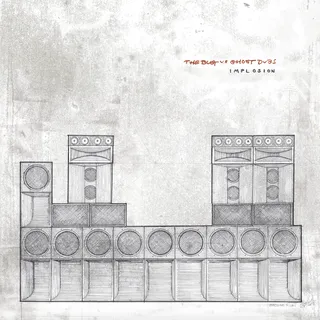
On “Implosion,” the collaboration between Kevin Richard Martin’s The Bug and Michael Fiedler’s Ghost Dubs feels less like a meeting of minds and more like a controlled collision. This is dub music stripped of warmth and comfort, rebuilt as something heavy, hostile, and deeply immersive. Where many collaborations aim for cohesion, Implosion thrives on friction, letting contrast become its defining energy.
Martin has spent decades bending dub into new shapes—industrial dancehall, bruised techno, and cavernous drone—and his side of Implosion continues that lineage with grim focus. His tracks move at a glacial pace, basslines dragging themselves forward like massive machinery. Named after long-shuttered clubs and venues, these pieces feel haunted, as if the sound is echoing through empty rooms thick with memory and dust. On moments like “Believers (Imperial Gardens, Camberwell),” ancient dub sirens and blunt bass hits feel sculpted rather than played, their sheer physical weight replacing melody or narrative. It’s introspective music, but introspection achieved through pressure.
There’s a mournful quality to Martin’s contributions that recalls the most politically charged ’70s dub—not protest music, but aftermath music. Tracks such as “Burial Skank (Mass, Brixton)” feel paranoid and inward-facing, like the comedown after collective euphoria, when the world creeps back in. Everything vibrates, but nothing resolves. Even the silence feels heavy.
Ghost Dubs, by contrast, brings motion where Martin brings mass. Fiedler’s tracks pulse with contained energy, drawing from dub techno traditions pioneered by acts like Basic Channel. His rhythms feel restless, always threatening to burst free. Sounds blur into abstraction—is that percussion, metal, or voice?—but the groove remains hypnotic. On tracks like “Hope,” stereo movement creates the illusion of broken machinery sputtering back to life, while “Midnight” drifts through metallic, liquid textures that feel almost weightless.
The brilliance of Implosion lies in how these opposing forces sharpen each other. Martin sounds heavier by contrast, Fiedler more agile and futuristic. Rather than blending their styles, the album stages them in opposition, like rounds in an underground soundclash. The result is tense, unsettling, and deeply rewarding for listeners willing to sit inside its pressure.
Implosion doesn’t aim to please. It aims to confront—and in doing so, it captures dub’s enduring power as both physical force and psychological space.
About the Author