December 01, 2025|Review
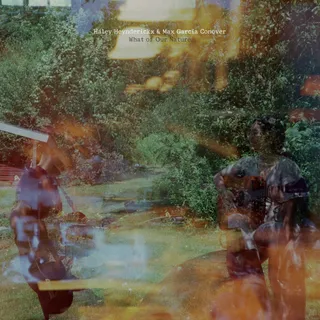
Haley Heynderickx and Max García Conover’s What of Our Nature arrives under the long, stubborn shadow of Woody Guthrie—a songwriter whose archive, stacked in unruly towers of napkins, placemats, and gift-wrap, feels like a single uninterrupted exhale of American radicalism. When Guthrie died in 1967, at just 55, he left behind 28 linear feet of unfinished songs for future generations to inherit like a box of loose instructions: keep singing, keep agitating, keep imagining something better. Plenty of artists have since grafted their own melodies onto his unrecorded lyrics—Billy Bragg & Wilco and the Klezmatics among the most successful—but Heynderickx and Conover pursue a more treacherous task. They aren’t resurrecting Guthrie’s words; they’re attempting to conjure his political imagination.
The pair’s earlier collaboration, 2018’s Among Horses III, floated in a surreal ecosystem of papaya trees, mantises, castles, and ghosts—an intimate, incantatory communion between Heynderickx’s tremulous, Shirley Collins-esque vocals and Conover’s tumbling, Lenker-like phrasing. What of Our Nature, recorded straight to tape in the woods of Vermont, stays rooted in the duo’s folkloric mysticism—wind chimes, rustling percussion, and meticulous fingerpicking—but now capitalism and colonialism arrive like trespassers on the land. Their songs still shimmer with “blushfern silversage” and “stag shape” visions, yet the shadows are full of “ticker tape accumulation,” “neoliberal sublimation,” and “starvation wages.” The natural world, once a sanctuary, becomes the stage for encroaching political decay.
Conover handles the album’s two sharpest political daggers, both tethered to 1981. “Song for Alicia” revisits the courtroom humiliation of Puerto Rican independence activist Alicia Rodríguez, incarcerated with members of the FALN who refused to recognize the legitimacy of their trial. “Buffalo, 1981” traces the Reagan-led dismantling of the PATCO strike—a rupture that still reverberates through American labor. These songs work like tiny, crystalline zines slipped into the tracklist: specific, instructive, and uninterested in metaphor. Elsewhere, though, the duo’s taste for abstraction can water down their arguments. Heynderickx can write a line like “the weightless wait behind the door of salvation metaphors,” then pivot to the blunt “They’re just making money off of us fighting.” Conover, too, is more vivid when he’s cryptic (“Montserrat money makers rooting in the rutabaga”) than when he’s literal (“The USA hates you being poor”). Their political fire is real; their phrasing occasionally flickers.
But part of What of Our Nature’s potency lies in its self-awareness—its recognition that songs are imperfect tools in moments of crisis. Conover imagines future listeners dismissing his catalog on “Song for Alicia”: “Songs are for sure not nearly enough.” Heynderickx, on “In Bulosan’s Words,” folds that doubt into determination: “The war’s gone long without us/Using the ammo of our tongues.” The album’s most triumphant moments, tellingly, come from borrowed language. Conover and Heynderickx erupt into Juan Antonio Corretjer’s legendary line—“I would be Boricua even if I was born on the moon”—with the same raw, high-throated conviction that once welded Emmylou Harris and Conor Oberst together on “Landlocked Blues.” Heynderickx builds another protest hymn from Carlos Bulosan’s America Is in the Heart, letting the poet’s clarion clarity do the striking. Here, poetry becomes the accelerant that their more diffuse writing sometimes struggles to access.
If their critique feels vaguer than the acid-tongued specificity of younger folk agitators—Jesse Welles calling out ICE by name, or songwriters invoking Netanyahu without euphemism—it may be because Heynderickx and Conover still cling, gently, to mystery. Their villains are “men in suits,” “the wealthy,” and a looming, faceless “they.” The mysticism that once made their music enchanting now risks blunting its political edge.
Bob Dylan, Guthrie’s most famous heir, famously followed a different muse when his protests turned razor-sharp; he credited Brecht, not Guthrie, for “The Lonesome Death of Hattie Carroll.” Heynderickx and Conover may need a similarly clarifying spark—something that harmonizes their ecological surrealism with the severity of their politics. But What of Our Nature is a stirring first attempt, a record that renews Guthrie’s democratic ethos even as it searches for the language to match the moment.
About the Author