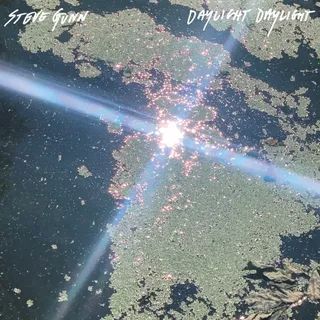
Steve Gunn has always played guitar like he’s signing his initials into the fabric of time. His phrases don’t merely unfurl—they arabesque, curl, dissolve, and reappear with the ornamental logic of someone writing with a quill by candlelight. Across improv sessions that scrape at the edges of noise, across soft-focus folk and rangy indie rock, his melodies tumble out like well-worn ragtime rolls, familiar but ghostly, as if dredged from some saloon piano in an earlier century. Yet Gunn plays with the unhurried patience of someone who refuses to hide behind his own technique. The notes come slowly, like careful exhales. What might read as virtuosic sleight of hand feels instead like excavation—his fingers brushing dust from artefacts he already knows by heart.
Daylight Daylight, his first proper singer-songwriter album since Other You, finds him lingering in the half-lit space between presence and disappearance. These songs don’t attempt to outrun death; they sit beside it, pour it tea, watch the shadows shift along the wall. Gunn has framed the record as a meditation on “hopeful death,” the kind that gestures toward renewal rather than fear. You hear it everywhere—in the way the music blooms cautiously, wilts gently, and re-roots itself in the silence after.
Taking cues from the arrested stillness of Spirit of Eden and Laughing Stock, Gunn and longtime collaborator James Elkington use empty space as a kind of cosmic instrument. The pair volleyed these seven songs back and forth, building them like two people restoring a found relic: careful strokes, soft cloth, nothing rushed or forced. The result feels antique without being nostalgic, intimate without being precious. If Gunn’s music has always thrived on subtlety, Daylight Daylight pushes that impulse to the edge; these small songs are played as if whispered over a shoulder to a single listener.
Elkington’s arrangements act like a prism for Gunn’s drifting melodic fragments. The acoustic clatter in “Nearly There” might, in isolation, suggest the gospel-tinged jangle of Primal Scream—but submerged in strings blurred like sunlight behind eyelids, the line turns tender, almost devotional. So much of the album works this way: scaled for a cathedral, delivered like a secret.
Gunn treats memory like a diorama on “Morning on K Road,” written after a chance encounter in Auckland with Hamish Kilgour not long before his passing. The song feels like rummaging through an old box of photographs: flashes of a leather jacket, a shared street corner, the sensation of stumbling into kindness on an ordinary afternoon. Nothing really happens; everything happens. Gunn simply notes, “The morning felt special,” and the song hangs suspended in that feeling.
Elsewhere, the album flirts with finality. “Nearly There” floats like a gentle ushering-out, bells ringing somewhere in the distance, Gunn singing as if dimming the lights for someone he loves. “Another Fade” drifts on woodwinds that scatter like dandelion seeds, the guitar solo arriving with the casual warmth of someone humming to themselves in the next room. “I feel the dream slip away,” he murmurs, not fighting its departure.
By the closing track, “A Walk,” Gunn strips back all metaphor. He gives instructions as if guiding a friend through a familiar clearing: look there, step here, feel the air. It’s a song about watching the world rearrange itself in slow motion—about how noticing can sometimes feel like grace. His guitar doesn’t lead anywhere in particular; it just meanders, patient and unhurried, trusting there’s enough time to witness the small things before they pass.
Daylight Daylight is a record obsessed with presence—not grand, triumphant presence, but the fragile, breath-to-breath kind. These songs hover between decay and renewal, offering comfort in the way only Gunn can: by reminding us that even the fading light has its own warmth.
About the Author