In the aftermath of An Inbuilt Fault, Will Westerman found himself drifting without a compass. The 2023 album—his densest, most inscrutable work, carved from hours of improvisational tangle and sharpened with Big Thief drummer James Krivchenia—did more than confound some listeners. It cost him his manager, his booking agent, and the gentle upward slope he’d been riding since “Confirmation” made him a patron saint of millennial sophisti-pop. But Westerman has never been shy about hitting reset. Even as the fault lines were widening around him, he was already sketching new material with engineer-producer Marta Salogni, whose ear for texture had elevated the very album that threatened to stall his career.
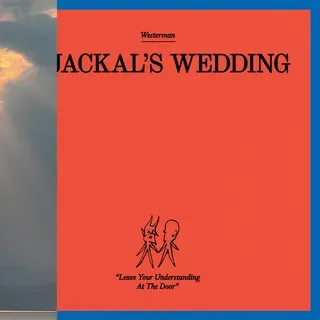
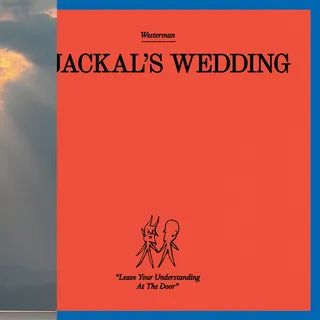
The pair decamped to Hydra, the mythic Greek island Westerman has long treated as a spiritual waypoint—he lived in Athens before Milan, and seems happiest in places where land meets water and time moves sideways. Over five weeks, they worked with an almost ceremonial refusal to fuss. The plan was simple: follow instinct, not theory; chase clarity, not cleverness. Somewhere between the pop translucence of Your Hero Is Not Dead and the heady thicket of Inbuilt Fault, they found a third path. A Jackal’s Wedding is the most distinctly Westerman thing he’s ever made: expansive yet hushed, wandering yet deeply grounded, an album that feels like it’s finally speaking in his own timbre rather than signaling its influences with a highlighter.
Salogni’s fingerprints are everywhere. These are some of the cleanest, most aerated arrangements in Westerman’s catalog, yet they carry the weight of their contradictions lightly. He steeped himself in Brian Eno and John Cale’s Wrong Way Up while writing, and you can hear it in the negative space—the way synthesizers behave like light hitting water, the way drums swell the mix instead of anchoring it. “PSFN,” short for “Pop Song, For Now,” has the dated cheeriness of an educational VHS tape, but the sly, hydraulic pulse of the production lands squarely in the present. “Spring,” a love song for his wife, is disarmingly direct, so guileless he joked it might be better off as an Adele pitch. This is the pop half of sophisti-pop finally stepping forward without shame, without filters.
The wooziness of his early EPs hasn’t vanished; it’s just repurposed. Opener “S. Machine” hints at a stranger album—synthetic horns wobble like a cross between 22, a Million and a long-forgotten Animusic demo—but the record soon settles into its more meditative pulse. Much of that gravity comes from Stella Mozgawa, whose drumming (and percussion upon percussion) channels Westerman’s restless interiority. On “Adriatic,” she constructs a kind of feverish buoyancy; on “Mosquito,” her dropped beats turn placidity into unease. Westerman, meanwhile, sounds newly embodied: there’s less falsetto, more chest voice, more grain. The comparisons to Bon Iver, for once, begin to fall away; instead he lands somewhere near Stephen Merritt’s baritone, with a wryness that suits him. When he sighs on “Adriatic,” “I head back to Ithaca… not New York,” it hits like a perfectly timed eye-roll delivered from a mountaintop.
Everything on A Jackal’s Wedding quietly orbits one song: the devastating “Weak Hands.” It was the first track he and Salogni touched, and it feels like the album’s true north, a beacon as much as a dirge. A meditation on mortality disguised as a pop song, it speaks in riddles—“My dear, my hologram, my lord of mirrors”—and yet lands with startling emotional directness. The primitive synth tones recall Your Hero Is Not Dead, but now they’re lashed to the ornate architecture of Inbuilt Fault, forming a surreal, trembling wall of sound. Ben Reed’s bass holds the floor, warm and understated, while Westerman delivers his most affecting vocal since “Confirmation,” clear-eyed and unvarnished.
Westerman has long been a composite artist—Talk Talk and Peter Gabriel in one pocket, Arthur Russell and art-rock arcana in the other. But A Jackal’s Wedding is the rare album where the references dissolve into something distinctly his. It’s his most spacious record, his most intimate, his most quietly self-assured. After losing the scaffolding that once propped up his career, he’s built something sturdier: a world of his own making, one that welcomes you in but never explains itself.
About the Author