Scrolling through EL PLVYBXY’s Instagram, you get the expected mythology: a snarling downtown renegade, blowing smoke into the Buenos Aires night and DJing sweat-slicked queer raves from Mexico City to Medellín. But read past the thirst-trap chaos and Gregorio Da Silva reveals himself as something else entirely—a studious decolonizer of the Latin American dancefloor, a technologist of folk memory, a grandson trying to make good on the legacy of Ariel Ramírez. Where his public persona leans delinquent and hypermodern, his music—released via subterranean hubs like Majía and TraTraTrax—betrays a composer’s discipline. Techno, footwork, cumbia, raptor house: Da Silva hurls these styles into collision with the precision of someone convinced rhythm can be a political gesture.
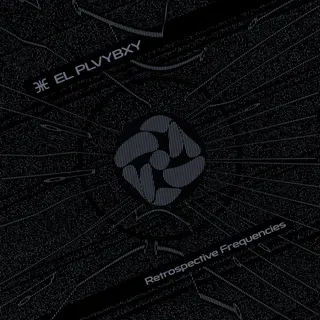
A debut album is a coronation moment for an artist already circulating through the global underground, and Retrospective Frequencies (on Mexico City’s scrappiest tastemaker, Terminal) feels like the first time Da Silva steadies his dualities into a single frame. It’s peak EL PLVYBXY—maximal, kinetic, and cheekily confrontational—but infused with a new sense of intention. Across 10 tracks, he melts nostalgic dance signifiers into an ever-shifting palette that slips between the organic and the synthetic until those distinctions become moot. Hard house, tribal house, raptor, techno, bass—they snap together with surprising ease. The wild card is guaracha, the Cuban percussion language that migrated through South America before mutating into a post-techno strain in the 2010s. Da Silva doesn’t quote it so much as refract it: hand drums become modular synths, melodic toms become distorted guitar licks, folk tradition rendered as circuitry. Though billed as a continuous narrative, the album behaves more like a cluster of short stories, each one set in a different corner of Da Silva’s psyche.
Opener “Asuntos Subacuaticos,” nodding to Drexciyan mythos, sinks into a murky throb that mimics deep-sea pressure; the beat arrives almost reluctantly, smooth and liquid but too vaporous to fully seize the ear. The real fuse is lit on “Bump Por Bump,” where twinkling flutes, fizzing lasers, watery basslines, and gasping vocal stutters intertwine in a composition that shapeshifts constantly without losing its gravitational center. EL PLVYBXY’s world expands through collaborators: “Los Cabures,” with fellow Argentine ROOi, fogs the speakers with enchanted-forest ambience—flutes, wood percussion, birdsong—before dissolving into digital shimmer. “Bohemio Del Sur,” a link-up with Chilean futurist Imaabs, is a controlled detonation: glitch scratches, rave stabs, guaracha hooks, and a jungle break chopped into confetti. The track feels like the sonic equivalent of a Latin American megacity intersection—horns blaring, motorcycles weaving, everything vibrating just short of collapse.
Sometimes Da Silva’s restraint scans as withholding. The title-mirroring “Frecuencias Retrospectivas” swells with tribal drums, electro fizz, and bright guaracha stabs but never cracks open; it taunts the listener with the pleasure of a drop that never comes. Yet the track articulates the album’s thesis: a refusal to confuse release with resolution. Relief arrives instead via “Venga,” built for peak-hour DJs and subwoofer-drunk dancefloors. It’s the album’s most carnal moment, its whispered “venga, venga” curling around a low-end throb tuned for vast spaces.
Da Silva’s instincts are most electric when he’s writing directly for bodies in motion. “ParisBsas” is a festival-tier knockout—festival fireworks rendered with the exactitude of someone who prefers the studio to the stage. Tribal drums and rippling synths chase an Amen break into euphoria, while serrated, Skrillex-adjacent squelches inject knowing grime. Expectations run even higher for “Goze,” a long-awaited meeting with raptor-house architect DJ Babatr, the godfather of low-income barrio futurism. Their collaboration is an acid-drenched rave track with a roller-coaster ascent that never quite tips over; the vocal loop is immaculate, but the drop lands more like a shrug. For two artists known to send crowds into spiritual collapse, it’s oddly muted—yet as a closer, the anticlimax syncs with the aquatic stillness of the opener, a deliberate displacement of EDM’s most sacred ritual.
What ties the album together is Da Silva’s meticulous governance of space. The mixes breathe, even when crammed with hyper-genre collisions. His priorities feel newly mature: less about detonating the dancefloor and more about exploring how micro-shifts in rhythm can alter the body’s internal weather. In the club, the subtlety feels sensual; on headphones, it can sometimes flatten into the sonic equivalent of mixing every paint color into brown.
-6a24284.webp/:/cr=t:0%25,l:0%25,w:100%25,h:100%25/rs=w:1280 "PHOTO: EL PLVYBXY")
Still, Retrospective Frequencies is a warm, freaked-out dispatch from an artist deepening rather than diluting his vision. It marks the end of EL PLVYBXY’s first arc—his guaracha-and-raptor-soaked beginnings in the South American rave continuum—and sketches only the faintest outline of where he might go next. Ambient rooms? Film scores? Something no one has a name for yet? Da Silva’s greatest strength has always been his refusal to obey the tropes of electronic music or the narratives assigned to Latin American futurism. Retrospective Frequencies feels less like a debut and more like a portal—one that suggests the most interesting version of EL PLVYBXY is still on the horizon.
About the Author