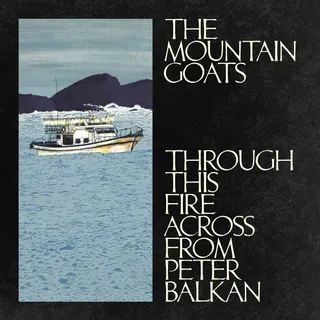
Peter Balkan sounds like he should exist somewhere between minor celebrity and Mountain Goats lore, a footnote whispered in coffee-shop debates about Darnielle’s most obsessive fans. In reality, Balkan is a recent invention of John Darnielle’s imagination—a name plucked from a dream alongside the title of the band’s 23rd album. Through This Fire unfolds around a doomed sea voyage, stranding three survivors on a shore where hunger, injury, and despair meet the absurd demands of survival. It’s a self-contained epic about endings and subsistence, a meditation on rising waters, climate anxiety, and humanity’s helplessness as the 21st century lurches forward. Yet, despite its catastrophic frame, Darnielle’s most intimate album in years lands with a curious universality.
Through This Fire is also the Mountain Goats’ most gleefully orchestrated record since Darnielle’s solo beginnings in 1991. Pedal steel, woodwinds, and strings—courtesy of multi-instrumentalist Matt Douglas—fold around Darnielle’s literate lyricism. This interplay is no accident: the trio at the album’s core is delirious, starving, and injured, and the musical arrangements mirror that chaotic mix of exhaustion and wonder. Lin-Manuel Miranda appears for backing vocals on several tracks, though his presence is barely distinguishable against Darnielle’s narrative command. Even on songs like “Fishing Boat,” where the first lines float like showtunes—“Free as the wind on the ocean / Wild as the rain in the storm”—Darnielle’s storytelling anchors the record.
The album’s three-act structure yields devastating imagery: “Nobody thought to carry a compass / It’s not the 19th century anymore,” he quips, and later, “You were already talking when I woke up today / For a man on combat rations, you sure do find a lot to say.” Flute, clarinet, and French horn lend warmth, while Jon Wurster’s drums punctuate with relentless, rolling energy reminiscent of Lou Reed’s Berlin. Tragic moments arrive with a quiet punch: Adam, one of the shipwrecked crew, drowns on “Rocks in My Pocket,” his reflection on fragile stones a melancholy meditation: “Some things are too fragile to name.” Darnielle’s young, unnamed protagonist echoes this tension: “Will you lie still while I reapply your bandage?”—a question that threads the line between rites of passage and funerary care. When the closing “Your Glow” widens the scope to global catastrophe—“If there’s nothing left but water / Then let water be enough”—Darnielle positions human resilience as simultaneous and inseparable from the natural world.
Yet Through This Fire occasionally falters under its own ambition. Its narrative sweep and orchestral grandeur sometimes overshadow the intimate songwriting that has defined Darnielle’s best work—from the countercultural elegies of Goths (2015) to the haunting domesticity of The Sunset Tree (2005). Tracks like “Broken to Begin With” offer swelling solos reminiscent of the Hold Steady, yet the album’s attempt at linear storytelling leaves some sequences feeling predetermined, the tension between miniaturist genius and epic sweep unresolved. Even the reprise of “Cold At Night” feels more like a structural tic than a thematic payoff.

Still, moments of lyricism pierce through the orchestral hull. “Everything that sinks will float,” Darnielle chants on “The Lady From Shanghai 2,” a line that carries literal and metaphorical weight. It recalls Jenny From Thebes (2023), where corpses and water towers intertwine with narrative rescue, underscoring Darnielle’s habit of recycling motifs to resist tidy closure. Death is inevitable, yet Through This Fire continuously throws out lifelines—threads of narrative and melody that let the listener swim alongside, rather than beneath, the waves. Momentum drives the album, sometimes at the expense of subtlety, but the ambition is emblematic of Darnielle’s craft: the ocean, after all, is not just wide—it is deep.
About the Author