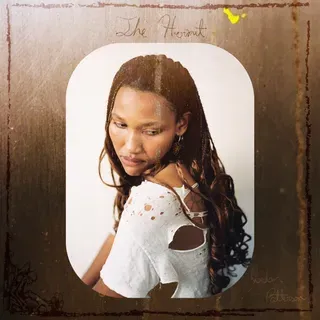
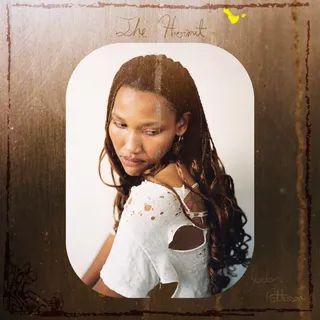
Jordan Patterson’s music feels like it’s moving along a familiar path until it suddenly slips out of frame. You can hear her roots in every phrase — the North Carolina softness of her vowels, the Roberta Flack warmth that shaped her, the Los Angeles polish earned at the County High School for the Arts (a breeding ground for Phoebe Bridgers, Haim, and Sasami). Her influences trace a clear line: from Nick Drake’s hushed intimacy to Radiohead’s weightless melancholy to the laptop-age logic of Ableton. But then there’s that voice — a tremor that refuses to sit still, an instrument that sounds like it’s discovering new ways to breathe in real time.
That voice doesn’t just carry her songs; it redefines them. It wobbles, stretches, and contracts like a lung inhaling at the point of collapse. Where most singers use vibrato as ornament, Patterson uses it as engine. The Hermit, her debut album, is practically 70 percent vibrato — a statistic that shouldn’t work, but somehow does. Her delivery lands somewhere between trembling prayer and electrical malfunction, a kind of post-cursive singing that dissolves the over-enunciated vowels of the Tumblr-era pop girls into something alien and unpretentious.
Strip away that vocal signature, and The Hermit could easily drift into coffeehouse anonymity. Its bones are simple: open chords, gentle percussion, lyrics that hum with everyday heartbreak (“right person, wrong time”). Yet Patterson never lets her songs settle. She keeps tilting their frames, letting odd textures and production quirks cut across the prettiness. The violin on “Stranger” squeals like a tea kettle about to boil over; “Jim” erupts in bursts of synth that sound like laser fire. These gestures don’t feel like experiments for their own sake — they’re the sound of someone testing the limits of sincerity, asking whether vulnerability can still sound strange.
That tension — between the raw and the refined, the folk and the fractured — animates the best moments of The Hermit. “God” is almost too much, cluttered with metallic clangs and skittering percussion, but its chaos feels like the point: faith rendered as a mess of frequencies. You can hear shades of early Laura Veirs in Patterson’s approach, that mix of craft and curiosity where the production doesn’t polish the songs so much as pry them open. Her world is intimate but never tidy.
There’s a bedroom-recording immediacy that runs through everything here. “I Can See the Mountains From Here” feels improvised, as though Patterson is playing to surprise herself. Her self-questioning is constant, and unfiltered: “What am I doing?” she asks on “Right Person, Wrong Time,” “Is it special? Is it right?” The line lands with a disarming kind of candor — the sound of someone still negotiating her own artistic identity in real time.
If The Hermit has a thesis, it’s that imperfection is the point. Patterson doesn’t chase mastery; she chases motion. The album captures the moment before control sets in, when instinct still outruns technique. That’s where her music lives — in the space between thought and form, where emotion hasn’t yet hardened into structure. On the closing track, “Jim,” as she gasps, “There is no end to this song,” her voice shakes like it could actually keep going forever. And maybe that’s what makes The Hermit so magnetic: it sounds like a young artist trying not to finish something too soon, clinging to the thrill of becoming.
About the Author