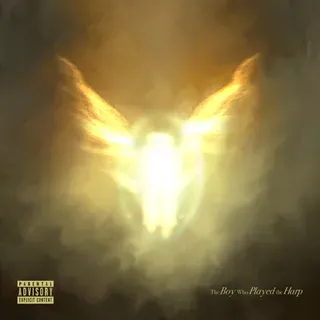
The opening scene could double as a film: a dimly lit restaurant high above the Thames, the city lights bleeding into the river below. Co-workers flirt with cocktails at the bar, the hum of conversation merges with the clatter of cutlery, and somewhere between them a woman silently films her plate for Instagram. At a table in the corner sit two generations of British rap: Dave, 27, self-aware and world-weary; and Kano, the elder statesman whose voice helped define the culture’s very language. Over wagyu steaks and quiet awe, they talk. This isn’t an imagined vignette—it’s the premise of “Chapter 16,” a track from Dave’s third studio album, The Boy Who Played the Harp, and the emotional anchor of his most inward-looking record yet.
Across six minutes, Dave and Kano converse like student and sensei, circling around mortality, legacy, and the cost of greatness. “Some years’ll worsen you and some will better you,” Kano advises, his tone less sermon than survival note. Over James Blake’s somber piano and falsetto laments, Dave reveals a man unraveling in slow motion: anxious about the youth who follow his footsteps, adrift in the privilege that once felt like salvation. “Love? I can’t seem to find it,” he confesses. The exchange is striking for its tenderness—two Black British men, both carved from environments that reward stoicism, talking openly about regret and the erosion of self. When Kano turns the questions back—“Can you ever see when you’re just someone’s wallet?”—it’s less interrogation than communion. The track sets the tone for an album obsessed with contradictions: power and guilt, faith and fame, isolation and communion.
For an artist who’s made his name dissecting the sociopolitical fabric of Britain, The Boy Who Played the Harp is startlingly private. The biblical allusion in its title isn’t accidental—like his namesake, Dave has spent his life using art to soothe something much larger than himself. But here, the harpist is exhausted. Four years since We’re All Alone in This Together, he’s wealthier, lonelier, and increasingly skeptical of the world that crowned him. The opening track, “History,” immediately places him in conversation with God, questioning whether survival at this level is victory or punishment. On “175 Months,” he prays for Congo with diamonds around his neck, the hypocrisy not lost on him. “Selfish” and “My 27th Birthday” are heavy with confession—of numbing himself with alcohol, of fearing emotional intimacy, of wondering if healing would erase the only self he’s ever known.
If Dave’s early career positioned him as the conscience of UK rap—an articulate moralist with a poet’s diction—then The Boy Who Played the Harp finds him recoiling from that role. His politics are no less present, but they’ve turned inward, refracted through personal guilt rather than outward critique. Gone are the blistering indictments of “Question Time” or the panoramic empathy of “Three Rivers.” Instead, Dave wrestles with his complicity in the very systems he once challenged. “How do I explain that I don’t wanna heal ’cause my identity is pain?” he asks, and the question echoes across the album like a bell tolling over empty streets.
Musically, The Boy Who Played the Harp is both refined and restrained. James Blake’s fingerprints are everywhere: glacial piano lines, spectral choirs, the quiet elegance of suffering rendered in high fidelity. The pacing is deliberate, almost claustrophobic, as if the production itself refuses to let Dave escape his own head. Still, there are flickers of light. “Raindance,” featuring Tems, softens his melancholy into something like grace—a balmy Afroswing ballad that feels suspended between desire and devotion. Jim Legxacy brings youthful disarray to “No Weapons,” while “Marvellous” pairs Dave’s storytelling with Spanish guitars and the faint pulse of the block he came from.
But the center of gravity always returns to the stillness—to the image of Dave alone with his thoughts, interrogating every triumph as though it might be a curse. His conversations with Kano and with himself form a mirror maze: both men aging within a culture that measures value by endurance, both haunted by what success demands they leave behind. Where Psychodrama externalized trauma and We’re All Alone in This Together expanded his empathy outward, The Boy Who Played the Harp turns the lens fully inward, until even the reflections start to distort.
The result isn’t his most accessible album, nor his most musically daring. It’s quieter, heavier, and occasionally suffocating in its self-scrutiny. But there’s an honesty here that feels braver than grand statements about Britain or Blackness. In the silence between piano chords and in the space between Dave and Kano’s words, there’s a realization that no amount of money, accolades, or critical reverence can insulate him from the work of becoming.
.webp/:/cr=t:0%25,l:0%25,w:100%25,h:100%25/rs=w:1280 "Dave")
By the album’s end, Dave seems to understand that isolation has limits—that even prophets need witnesses, even golden boys need guidance. The Boy Who Played the Harp isn’t about redemption so much as recognition: of the frailty behind the composure, of the noise behind the stillness, of the man behind the myth.
About the Author