.webp/:/cr=t:0%25,l:0%25,w:100%25,h:100%25/rs=w:1280)
Makaya McCraven doesn’t simply make jazz records—he builds ecosystems. Each performance, each tape reel, each meticulous edit exists as part of a perpetual feedback loop between spontaneity and structure. Improvisation becomes composition, composition melts back into improvisation, and the process begins again. The Chicago drummer-producer’s approach feels almost alchemical: jazz reshaped with a hip-hop producer’s precision and a scientist’s patience. He plays, records, deconstructs, and rebuilds—turning the energy of a live set into something sculpted, something eternal. It’s the sound of someone not just performing music, but reimagining how music can live, breathe, and evolve long after the show ends.
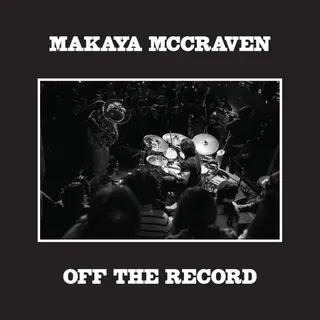
Off the Record, a sprawling set of four new EPs—each released individually and then bound together—acts like a panoramic snapshot of McCraven’s ongoing experiment. Rather than tracing a linear progression from his 2015 breakthrough In the Moment, it operates like a prism: turn it slightly and the light refracts differently. Across these 16 tracks, McCraven blurs the lines between live improvisation and studio manipulation, revealing how porous the barrier between them truly is. One moment, he’s the deft, quicksilver percussionist steering a room of world-class players; the next, he’s the beat scientist behind the boards, looping fragments until they pulse with a new logic. His collaborators—veterans like Jeff Parker and Ben LaMar Gay, or newer fixtures like vibraphonist Joel Ross—help illuminate each facet, yet the guiding voice remains unmistakably his.
The PopUp Shop EP captures McCraven at his most direct. “We’re about to be makin’ some stuff up right here on the spot,” he tells the crowd, his voice warm and conspiratorial. That promise of improvisation, though, becomes something else entirely by the time we hear it. “Venice,” culled from that same 2015 set, feels reassembled in the lab, its Dilla-coded drum loops and bass grooves snapping with post-production intent. Even amid the electricity of the performance, McCraven’s edits lend an uncanny composure—proof that freedom and form are not opposites but dance partners. “Imafan” floats in that liminal zone between live spontaneity and after-the-fact design: Justin Thomas’ vibraphone blooms freely, only for its phrases to circle back, repeating in ghostly echoes. You can almost hear McCraven extending time, elongating feeling.
By contrast, Hidden Out!—drawn from a 2017 Hideout gig in Chicago—reveals McCraven’s long game. These tracks simmered for eight years before surfacing, their seamlessness born from patience and obsessive revision. “News Feed” starts with crowd chatter and unspools into something cinematic, a noirish groove that feels too perfect to be improvised, too human to be programmed. Then the illusion cracks: that vibraphone you swore was live? Added later. Elsewhere, on “Away” and “Dark Parks,” his rhythmic sense turns elastic, a living pulse stitched together from a thousand invisible edits. McCraven isn’t erasing imperfection; he’s teaching imperfection to groove.
Techno Logic stands apart, both temporally and tonally. Spanning 2017 to 2025, it’s an amalgam of eras, anchored by Theon Cross’ thunderous tuba and Ben LaMar Gay’s mercurial presence. Gay is less a featured artist here than a co-conspirator—a force of joyful chaos who turns McCraven’s tightly wound experiments inside out. On “Gnu Blue,” his chant hovers like a mantra over a rhythm section teetering on collapse. “Technology” takes that collapse literally, simulating digital decay through tuba bursts and skittering percussion, while Gay half-sings, half-laughs a line that could double as McCraven’s artistic statement: “Many, many, many years behind what we’ve got already.” When Gay picks up a homemade diddley bow on “Strikes Again,” he bridges eras and aesthetics with a single note, transforming a rudimentary blues instrument into a futuristic pulse.
Finally, The People’s Mixtape feels like the culmination—a celebration of everything McCraven has learned to weave. Recorded live at Brooklyn’s Public Records in 2025, it features one of his tightest ensembles yet: Paul on bass, Hill on trumpet, Ross on vibes, Chiu on synth. The chemistry is telepathic. “The Beat Up” charges forward like a runaway train of rhythm, every instrument pushing against the beat without derailing it. Even the more meditative “Lake Shore Drive Five” hums with quiet propulsion, as if the city itself were breathing through the band. When the crowd fades back in at the end, the illusion collapses again: this is still live music, still human, still searching.
.webp/:/rs=w:1280 "Makaya McCraven")
What McCraven has built with Off the Record isn’t a set of recordings so much as a methodology—a redefinition of jazz’s relationship to time, memory, and iteration. His work acknowledges that music doesn’t die when the band leaves the stage; it transforms, regenerates, folds back into itself. Every edit is an act of resurrection. Every loop is a conversation between the present and the past. McCraven’s art exists in that loop—forever unfinished, forever alive.
About the Author