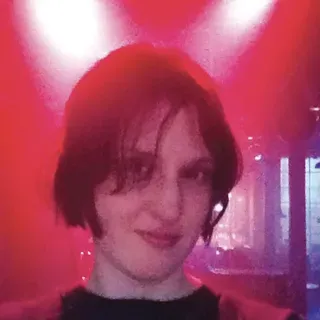

In Joanne Robertson’s oil paintings, dense knots of red and brown often settle in the lower left corner, pressing against pools of pale color like a visual echo of her music’s pulse. Those earthy shades mirror the quiet turbulence beneath her songs—melodies that twist, fracture, and dissolve within their own serenity. Much like her frequent collaborator Dean Blunt, Robertson blurs the boundaries between her art forms: her painting informs her music’s sense of tension and movement. She navigates both mediums with supple spontaneity, guided by intuition rather than plan—but it’s within her music that she reaches toward something transcendent.
Blurrr, her sixth solo album and an undeniable masterpiece, achieves a rare, breath-stealing beauty—at moments so pure, like 53 seconds into “Always Were” or four and a half minutes into “Peaceful,” that time seems to halt. Robertson’s sound feels unbound by space, as if recorded somewhere beyond the limits of the physical world. For forty-five minutes, Blurrr creates its own dimension—a lo-fi mirage of the Cocteau Twins’ lush haze. Like Elizabeth Fraser, Robertson expands her voice beyond language, bending words into tones and gestures. But where Fraser’s singing is a kind of ecstatic abstraction, Robertson’s retains the ghost of meaning. Her lyrics hover in the in-between—almost clear, yet never quite deciphered.
Comparisons to Grouper also hold: both artists summon vast solitude, their melodies and words surfacing like relics of distant memories. Yet Robertson refines these fragments through her voice—transmuting emotion as she delivers it. On “Gown,” she opens her full range, her voice trembling with yearning and ache; on “Ghost,” she sings as though attempting to claim the infinite itself. Her guitar doesn’t merely accompany her—it converses with her voice, tangling in rhythmic knots, resonating like the red-and-brown strokes of her paintings: tactile, raw, alive.
Robertson’s music speaks to itself. She lingers on guitar phrases longer than expected, or follows the curve of a vocal line just because it feels right. This self-dialogue, shaped by the free jazz ethos that informs her art, isn’t about chaos but conversation. Like Cecil Taylor, she builds structure from motion and feeling rather than harmony. Her songs are encounters rather than compositions—journeys that move forward endlessly, pulled by an unseen gravity.
And yet, Blurrr is also profoundly solitary. More than ever, Robertson sounds enclosed in her own world, as if she’s forgotten the concept of an audience. Her songs capture the murmur of thought itself, translating the colors of consciousness into melody. For her, solitude becomes freedom—a space for unfiltered exploration, unguarded and audacious.
In the album’s second half, cellist Oliver Coates joins her, tracing the contours of her loneliness and magnifying its quiet grandeur. His warm, sustained tones lift Robertson’s fragile sketches into something celestial. Together, they create moments of near-divine clarity—his cello encircling her voice like light through stained glass. Coates plays not as an interpreter, but as someone who truly feels the emotional scale of her work. Their duet embodies pure empathy—no restraint, no distance, only a shared current of feeling.
By each song’s close, Robertson herself recedes, leaving us instead with the sensations that animate her music: tragedy, rapture, and the haunting persistence of memory. “Mystery gone into—wait, take it with you,” she sings on Gown. On paper, the words seem fragile; sung, they wound. The silence that follows carries their weight. Blurrr is a vast work rendered in small strokes—an epic in miniature. And when it ends, it doesn’t leave you behind. You carry it with you.
About the Author