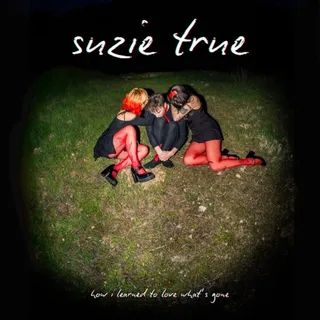
Suzie True are a fan’s band in the truest sense—self-mythologizing, referential, and proudly uncool. Named after a line from a ’90s Oblivians song and once described as “if the Powerpuff Girls formed a Blink-182 cover band,” they wear their pop culture neuroses like patches on a denim vest. Their songs orbit nostalgia not as decoration, but as survival tactic: “Collecting hearts like Pokémon / She’s such a ch-ch-cherry bomb!” is less a cute rhyme than a way to process being young, online, and constantly performing. Every chorus feels like a daydream turned coping mechanism—music for slamming your bedroom door because no one understands, or for pretending your hometown loop is a movie montage. It’s easy to mistake the band’s obsession with Y2K pop-punk and teenage melodrama for shtick, but Suzie True are too sharp for that. They know exactly what they’re doing—reclaiming the hyper-feminine hysteria that was once a punchline and turning it into power.
“I used to be young and dumb / Now I’m just dumb,” sings Lexi McCoy on 2023’s Sentimental Scum, her deadpan delivery landing like a confessional and a punchline at once. On How I Learned to Love What’s Gone, she doubles down on that tension between self-awareness and self-sabotage. McCoy’s writing is an act of resistance disguised as self-deprecation: she weaponizes her arrested development against a culture that punishes women for aging out of ingénue status. “As long as I look 23 on my 30th birthday, everything will be alright,” she half-jokes on “Get Prettier Overnight!!!”—a line that sounds ripped from a millennial group chat, scored by Weezer guitars and a wink to the Josie and the Pussycats soundtrack. It’s funny until it isn’t. Underneath the glitter is a deep fear of obsolescence, of being seen as past the age when heartbreak still sells.
.webp/:/cr=t:0%25,l:0%25,w:100%25,h:100%25/rs=w:1280)
Chris Farren’s production walks a tightrope between polish and mess. The record hums with radio-ready brightness, but it never scrubs away the band’s basement charm. G Leonardo’s guitars are chunky and unpretentious, every downstroke a callback to burned Warped Tour CDs. On “Leeches (Play Dead!),” McCoy squeals, “Be a good girl for you and play dead,” a line that collapses gender performance, apathy, and survival into one desperate pop hook. Then there’s “Glow,” where she fires off one of her best one-liners—“You’re just like my student loans / If I ignore you then you don’t exist”—before laughing it off like she didn’t just summarize modern adulthood in 12 syllables. Even the lighter tracks carry emotional bruises; “Oh, Baby!!!” begins as a breezy girl-group fantasy before the chorus detonates like a skateboard hitting concrete.
Suzie True sound like they’re permanently in the throes of a crush—on people, on nostalgia, on the chaos of their own feelings. That’s both their greatest strength and their glass ceiling. Two songs here have “love” in the title; three include exclamation points, as if punctuation alone could convey the emotional velocity. But within all the mascara-streaked melodrama, there’s a kind of truth that feels radical in its sincerity. Suzie True understand that pretending to be fine is overrated. On How I Learned to Love What’s Gone, they make a convincing case that refusing to grow up might be the most adult decision of all.
About the Author